Puente la Reina to Villatuerta The Quiet Kilometers
No mountain pass. No famous cathedral. No dramatic Camino crisis. Just vineyards, old stone villages, rolling Navarra farmland, and enough quiet walking for my brain to finally stop talking.
Some Camino days are headliners.
Mountain passes. Famous bridges. Cathedrals that stop you in your tracks. Villages you have already seen fifty times on somebody else’s Instagram feed.
Then there are days that are simply kilometers.
Honest, rolling, sunlit kilometers through Navarra, with one foot following the other beneath a sky that seems considerably larger once nobody is trying to turn it into an attraction.
Day 10 from Puente la Reina to Villatuerta was one of those days.
And I have started to think the quiet days may be where the Camino does some of its best work.
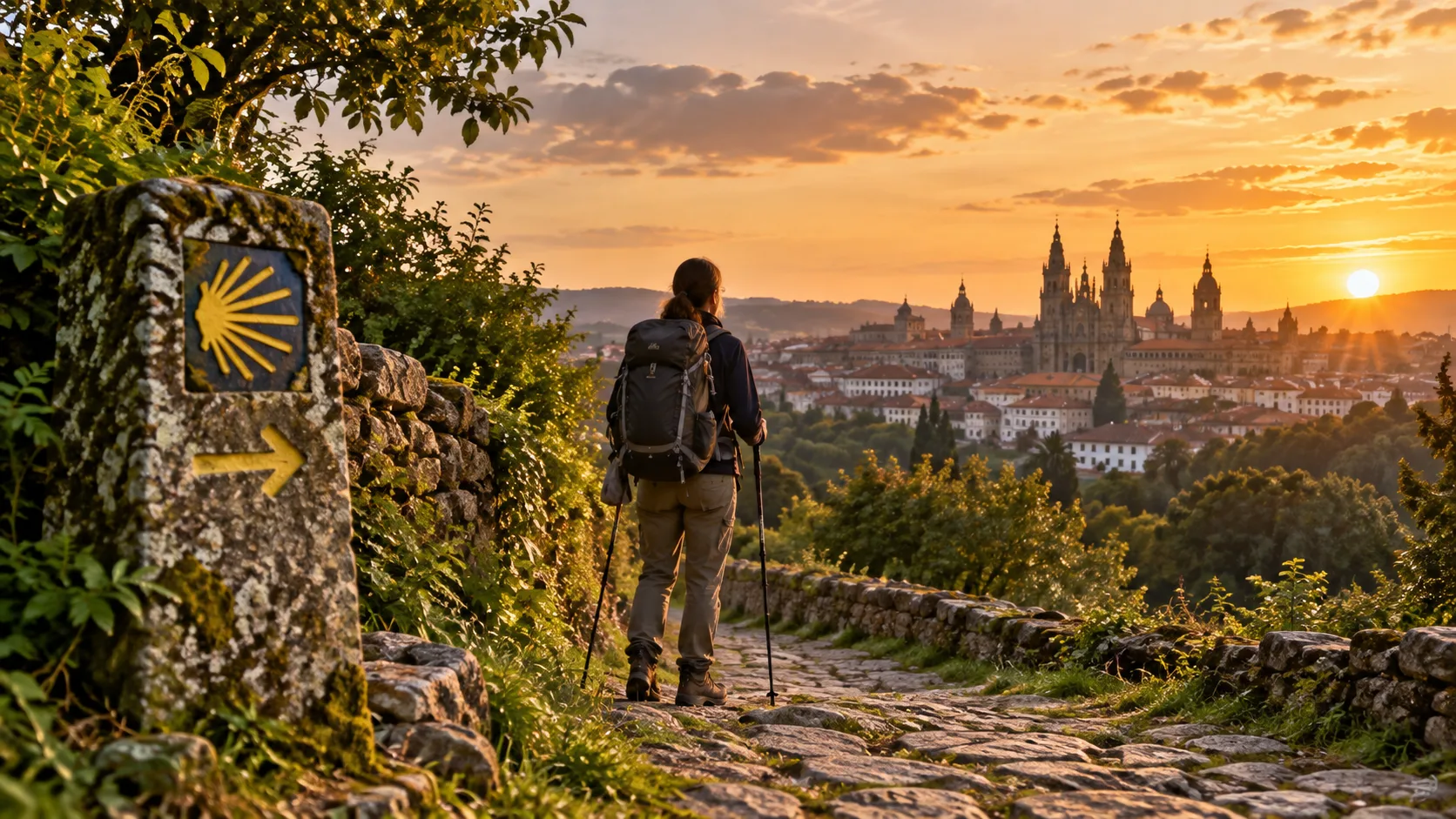
Sage and I left Puente la Reina behind and followed the yellow arrows west through vineyards, cereal fields, olive groves, and small Navarra villages.
Mañeru came first.
Then Cirauqui, sitting on its hill as if somebody had deliberately placed an old stone village exactly where tired pilgrims would have to climb toward it.
Beyond Cirauqui, sections of old stone roadway appeared beneath our feet. The history did not arrive with a dramatic soundtrack.
It was simply there.
Some days the Camino gives you a monument.
Some days it gives you enough silence to notice
the road itself.
Camino Francés · Stage 10
Puente la Reina to Villatuerta at a Glance
| Stage detail | Information |
|---|---|
| Route | Puente la Reina → Mañeru → Cirauqui → Lorca → Villatuerta |
| Region | Navarra, Spain |
| Approximate distance | About 17.5–18 km / roughly 11 mi on the standard Camino route |
| Personal GPS distance | Not recorded in my Day 10 notes |
| Terrain | Rolling agricultural tracks, village streets, hills, and sections of old stone roadway |
| Main communities | Mañeru, Cirauqui, Lorca, and Villatuerta |
| Difficulty | Moderate rolling Camino terrain without a major mountain crossing |
| Main highlight | Cirauqui and the historic stone road beyond the village |
| Traditional stage | Many itineraries continue beyond Villatuerta to Estella-Lizarra |
| Our finish | Villatuerta |
| Stage theme | The quiet kilometers |
Distance note: the approximately 18-kilometer figure is a route-planning estimate rather than a number from my watch. Camino distances vary by GPS track, accommodation, detours, and exactly where you begin and end the day.
This was Day 10 of my Camino Francés . The previous day took Sage and me over Alto del Perdón and into Puente la Reina.
You can read Day 9: Zariquiegui to Puente la Reina or begin with my complete Camino Francés itinerary .
Leaving Puente la Reina
The previous day had ended with one of the great visual moments of the Camino Francés.
Puente la Reina’s medieval bridge.
Stone arches stretching across the river. Centuries of pilgrims crossing west. Two historic Camino traditions drawing together.
Day 10 began by leaving all of that behind.
That is another thing the Camino does well.
Yesterday’s landmark becomes this morning’s disappearing skyline.
The Camino rarely lets you admire yesterday
for very long.
There is always another yellow arrow.
West of Puente la Reina, the landscape opened again. Vineyards, cereal fields, olive groves, dirt tracks, and low hills replaced the drama of Alto del Perdón.
There was no enormous obstacle dominating the horizon.
We simply walked.
Mañeru: The Camino Settles Into Navarra
Mañeru arrives roughly five kilometers after Puente la Reina.
It is not a famous Camino headline.
That suited the day perfectly.
The route moves through the village and then returns to agricultural land, where vineyards and open fields begin framing the next destination.
Cirauqui appears ahead on its hill.
Like many hill towns on a walking route, it looks delightfully picturesque from a distance and slightly less charitable once you remember that your legs have to climb into it.
Suspicious elevation.
Cirauqui: A Village Built Above the Road
Cirauqui sits high enough above the surrounding farmland to make the approach memorable.
Narrow streets and old stone buildings pull the Camino upward through the village before the route eventually begins descending again on the western side.
This is the kind of place where the Camino’s age becomes physical.
Not because somebody has installed an enormous interpretive sign telling you how ancient everything is.
Because the road itself starts making the argument.
Stone under your boots.
Worn edges.
Uneven surfaces.
A path shaped by movement rather than designed for comfortable modern walking.
You walk through history differently when history is the thing trying to twist your ankle.
The Old Road Beyond Cirauqui
Beyond Cirauqui, the Camino follows stretches of old stone roadway traditionally associated with an ancient route toward Astúrica—the Roman city that became modern Astorga.
I like the careful version of that history.
It is tempting to point at every weathered stone and announce:
History is usually messier than that.
Roads are repaired.
Stones are replaced.
Medieval pilgrims walk across routes that existed before them, and modern pilgrims walk across surfaces rebuilt after both.
What matters to me is the continuity.
People have been moving through this landscape for a very long time.
Traders.
Soldiers.
Farmers.
Pilgrims.
And now Sage and me, walking west with backpacks, sore legs, and considerably better footwear.
Walking on Layers of Time
This section of the Camino made me think about how quietly history survives.
A cathedral announces itself.
A castle occupies a hilltop.
A museum puts the important object beneath glass.
An old road does none of that.
It simply remains useful.
You step onto it because the yellow arrow points that way.
That may be one of the most honest forms of history there is.
When Nothing Happens, You Finally Show Up
Here is the strange thing about a Camino day without a major event:
There is nothing to distract you from being present.
No summit to chase.
No famous monument waiting for its photograph.
No brutal descent demanding every gram of your concentration.
Just rhythm.
Step.
Step.
Breath.
The crunch of the path.
Heat building.
A patch of shade becoming the most important piece of real estate in Navarra for ninety seconds.
The spectacular days give you memories.
The ordinary days give your mind somewhere
to go quiet.
During the first week of a long walk, my brain remained noisy.
To-do lists.
Old conversations.
Things I should have done.
Things I still needed to do.
The entire anxious mental browser running with forty tabs open at once.
Then something started changing.
Not during a spiritual ceremony.
Not beneath a dramatic sunset.
Somewhere on an ordinary stretch of Camino through Navarra, the tabs began closing by themselves.
One by one.
I stopped narrating every kilometer.
I stopped measuring the day against the destination.
I just walked.
You cannot force that kind of quiet.
You can only walk long enough for your brain to
eventually surrender.
Cirauqui to Lorca: Nothing to Conquer
The marked Camino continues west from Cirauqui toward Lorca before turning toward Villatuerta.
The terrain continues to rise and fall rather than offering one dramatic climb.
That distinction matters.
A mountain gives you something obvious to fight.
Rolling terrain just keeps arriving.
Another rise.
Another descent.
Another patch of dirt road.
Another cluster of buildings slowly changing from a mark on the horizon into somewhere you can refill, rest, or continue walking through.
Day 10 was not asking for heroics.
It was asking for consistency.
Stopping in Villatuerta
Villatuerta is close enough to Estella that many pilgrims simply continue.
We did not.
And that is exactly why I remember it.
It felt calm.
A small Camino town without the pressure to transform itself into a grand finale.
A place to put the backpack down.
A place to stop moving.
A place to allow an uneventful walking day to remain uneventful.
The Camino does not owe you a revelation every evening.
Sage and I shared a simple dinner and watched the evening light turn gold across the fields.
There was no dramatic story attached to it.
Nobody made a speech.
Nothing went wrong.
Nothing needed fixing.
We ate.
We rested.
The day ended.
Which was the whole point.
Why Stop in Villatuerta Instead of Estella?
A traditional Camino itinerary often carries this day all the way from Puente la Reina to Estella-Lizarra.
That is useful information.
It is not a court order.
We had already learned this lesson before Puente la Reina. Published Camino stages help you understand distances, services, accommodation, and terrain.
They do not know your body.
They do not know how you slept.
They do not know what yesterday took out of you.
They certainly do not know whether the quiet town four kilometers before everybody else’s destination is exactly where you need to stop.
Use Camino stages as planning tools, not moral standards. Stopping in Villatuerta does not make the stage incomplete. The best distance is the one that lets you wake up tomorrow capable of continuing.
That philosophy is becoming one of the recurring themes of my Camino Francés.
I am increasingly less interested in how far somebody thinks I am supposed to walk.
I am much more interested in building a journey I can continue.
Puente la Reina to Villatuerta: Quick Answers
How far is Puente la Reina to Villatuerta?
The standard Camino route is approximately 17.5–18 kilometers, or about 11 miles. Exact totals vary by GPS track, detours, and where you stay.
Which villages are between Puente la Reina and Villatuerta?
The Camino Francés passes through Mañeru, Cirauqui, and Lorca before reaching Villatuerta.
Is Cirauqui worth stopping in?
Yes. Cirauqui is one of the most memorable villages on this section, with steep stone streets and an old roadway beyond the village traditionally associated with the ancient route toward Astúrica.
Is the road after Cirauqui Roman?
It is commonly described as Roman or as part of an ancient road toward Astúrica, but the visible surface has been altered and repaired over many centuries. It is more accurate to describe it as an old historic roadway with Roman associations than to assume every stone dates directly from Roman times.
Do most pilgrims stop in Villatuerta?
Many traditional itineraries continue several kilometers farther to Estella-Lizarra. Villatuerta can make sense for pilgrims who prefer shorter stages or simply want to stop before the larger town.
What comes after Villatuerta?
The Camino continues toward Estella-Lizarra. My Day 11 continues beyond Estella and the Irache area toward Villamayor de Monjardín.
What Camino Francés Day 10 Taught Me
Day 10 taught me something the dramatic stages cannot.
A journey cannot be made entirely of highlights.
It needs ordinary miles.
It needs mornings when nothing remarkable happens.
It needs landscapes that do not demand a photograph.
It needs stretches where the body simply walks and the mind slowly discovers that it no longer needs to fill every empty space.
Boredom is not always the absence of experience.
Sometimes it is the doorway into attention.
I had spent years living with a brain trained to look for the next thing.
The next task.
The next problem.
The next destination.
Walking does something strange to that habit.
Eventually there is no next thing.
There is only the next step.
And then another.
Day 10 did not give me a dramatic Camino story.
It gave me something quieter.
Enough space to stop looking for one.
Keep Planning the Way
The journals tell you what happened on our Camino. These guides can help you make better decisions for your own.
Atypical Last Thoughts
Day 10 was pure, honest Camino.
No mountain pass.
No famous bridge waiting at the finish.
No crisis to overcome.
Just Navarra beneath our feet and enough kilometers for the mental noise to begin draining away.
We walked through Mañeru and Cirauqui, crossed old stone roads, followed the yellow arrows through farmland, and stopped in Villatuerta while many pilgrims continued toward Estella.
Sage and I ate a simple dinner and watched the evening light settle across the fields.
Nothing happened.
And for once, I did not need anything to.
Some days the trail’s gift is a summit.
Some days it is a cathedral.
Some days the gift is that nothing happens at all.
Buen Camino.