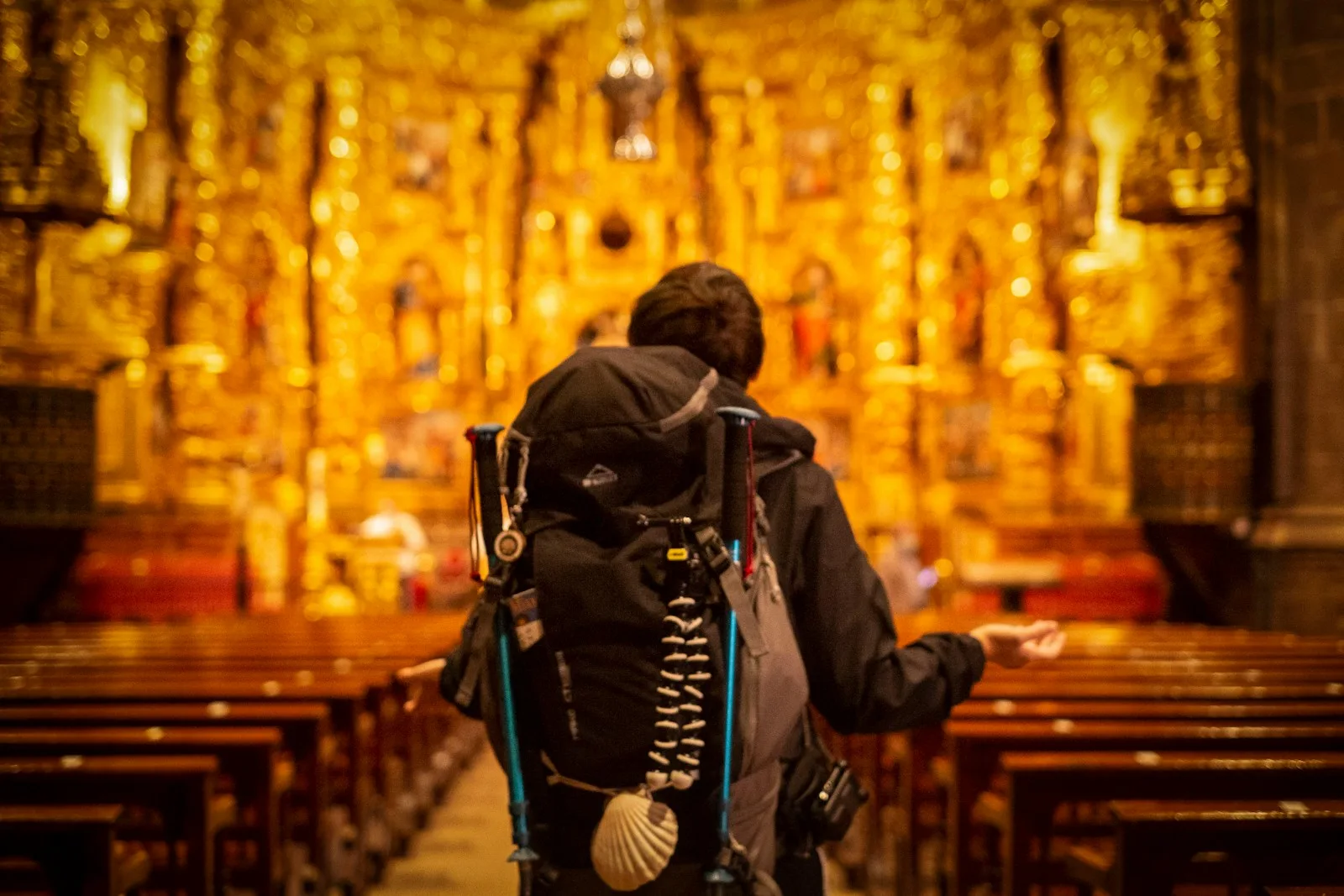
There is a moment on the Camino de Santiago when the whole thing stops feeling like a hiking trip. It did not start for me as a polished spiritual quest with perfect gear and a dramatic sunrise soundtrack.
It started with a backpack, sore feet waiting to happen, and the feeling that walking across Spain might shake something loose in me.
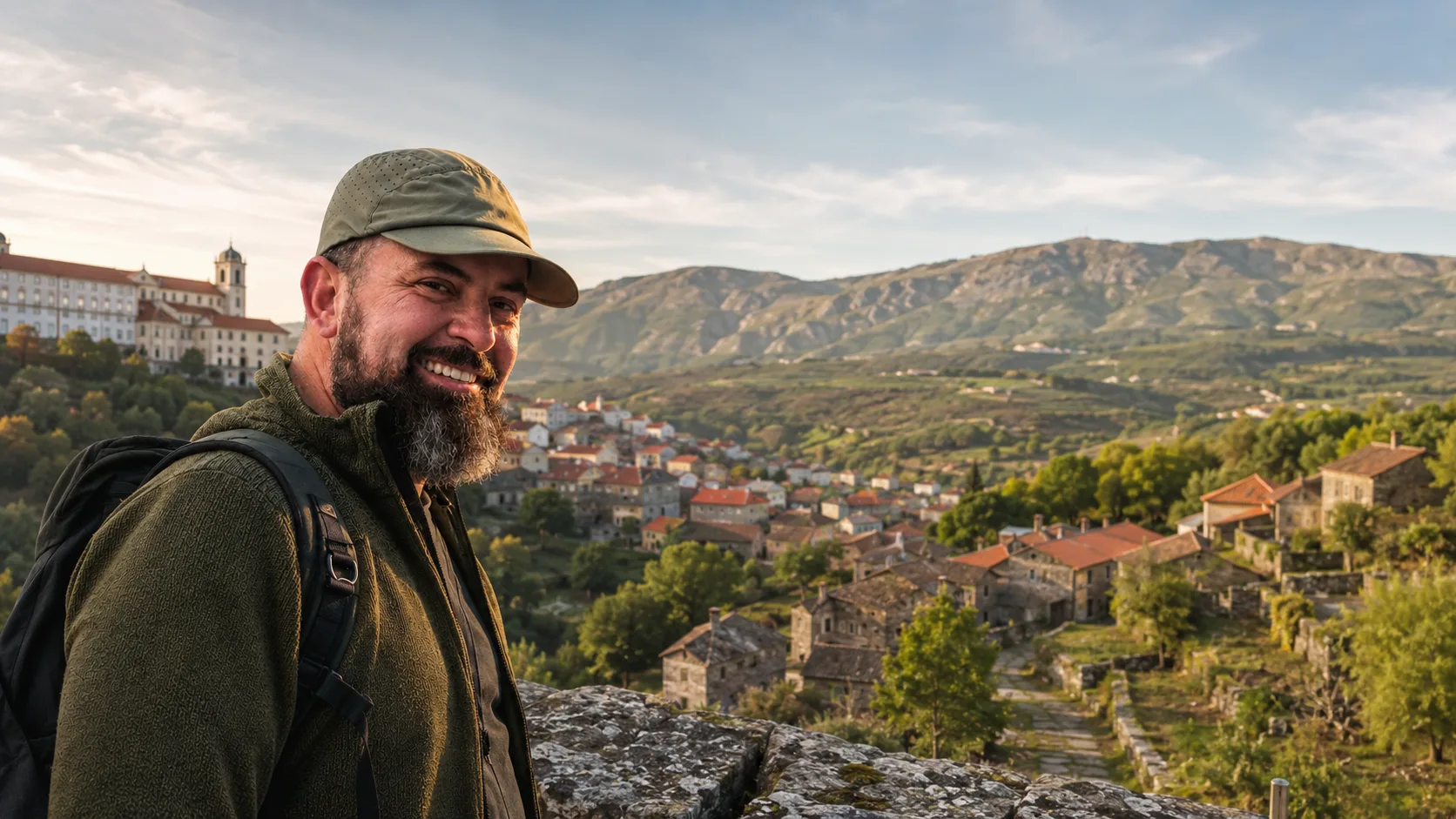
I’m Carter, the traveler behind Atypical Vagabond, and I’ve walked both the Camino Portugués and the Camino Francés, including a 51-day journey from Saint-Jean-Pied-de-Port to Santiago with my wife, Sage. So when I write about the Camino, it is not from theory. It is from trail dust, wrong turns, albergue chaos, rainstorms, blisters, bad coffee, good bread, and the strange little miracles that appear when you keep following the yellow arrows.
The Camino is not just a hike. It is part pilgrimage, part endurance test, part cultural deep dive, and part emotional garage sale.
Some people walk for faith. Some walk for grief. Some walk for adventure, transition, recovery, or because life has become too loud and they need one simple thing to do each day: walk.
This page is my honest guide to the Camino de Santiago: the major routes, planning tips, costs, albergues, packing advice, training, mistakes to avoid, and what walking the Way actually feels like once the romantic idea meets your knees.
Because the Camino is beautiful.
It is also uncomfortable, humbling, hilarious, and occasionally powered by vending machine coffee.
And that is exactly why it stays with you.
Maybe it happens while crossing a mountain in sideways rain, over bad coffee in a village you had never heard of before, or when a stranger offers you food, directions, or a seat beside them.
For me, it happened somewhere between aching feet, terrible weather, wrong turns, and the strange realization that I was becoming emotionally attached to a yellow arrow.
The Camino may begin as a walk across Spain, but somewhere along the Way, it becomes something far more personal.
The Camino de Santiago is often described as a pilgrimage across Spain. That is technically correct, but it barely scratches the surface.
It is a physical challenge, a cultural journey, a moving community, and occasionally a long conversation with yourself that you did not ask to have.
Along the Way, you will pass through:
- Historic cities
- Tiny farming villages
- Forests and mountain passes
- Vineyards and open countryside
- Industrial outskirts
- Long stretches where your only entertainment is wondering why you packed three shirts that all smell equally terrible
What You Will Find in This Camino de Santiago Guide
- The major Camino de Santiago routes
- How to choose the right route
- Accommodation and albergues
- Camino costs and budgeting
- Training and daily distances
- Packing and footwear
- Food, water, and trail safety
- Pilgrim etiquette and Camino culture
- The realities travel brochures tend to skip
Because the Camino is not only cathedrals, mountain views, and inspirational sunsets.
It is also pain, uncertainty, loneliness, laughter, blisters, terrible sleep, unexpected kindness, and beautifully strange people from around the world.
Welcome to the Way.
What Is the Camino de Santiago?

The Camino de Santiago is a network of pilgrimage routes leading toward Santiago de Compostela in northwestern Spain.
Pilgrims have traveled these paths for centuries to reach the Cathedral of Santiago de Compostela, traditionally associated with the remains of Saint James the Apostle.
Today, the Camino attracts people from nearly every background imaginable.
You will meet:
- Religious pilgrims
- Long-distance hikers
- Retirees
- Students
- Digital nomads
- Solo travelers
- Couples
- Families
- People navigating grief or major life changes
- Travelers who simply thought walking across Spain sounded like a good idea
Some pilgrims walk hundreds of kilometers. Others complete a shorter section.
There is no Camino police force hiding behind a tree waiting to confiscate your credential because you took a bus, carried less gear, or skipped a stage.
Your Camino is your Camino.
That sentence gets repeated often because people need to hear it.


My reason for walking
I did not approach the Camino as a perfectly polished pilgrim. I arrived carrying my own history, questions, frustrations, and emotional baggage. Unfortunately, emotional baggage does not come in an ultralight version.
The Camino became a place where daily life was stripped down to a few essential questions:
- Where am I walking?
- Where am I sleeping?
- Do I have enough water?
- Why does my left knee hate me?
What initially looked like a trail across a map became something much more personal.
Walking day after day forces you to slow down. You cannot outrun every uncomfortable thought when your primary form of transportation is your own battered feet.
That is where the Camino begins doing its weird magic.
The Main Camino de Santiago Routes
There is no single Camino de Santiago route. The Way is made up of multiple historic paths beginning in Spain, Portugal, France, and elsewhere in Europe.
Each route offers a different combination of distance, scenery, infrastructure, difficulty, and solitude. Choosing the right route is one of the most important parts of Camino de Santiago planning.

From there, the route travels through northern Spain toward Santiago de Compostela. The full Camino Francés is roughly 780–800 kilometers, depending on the path, detours, and how often you accidentally wander toward a bakery.
The Camino Francés includes:


Read more
- Camino Francés Complete Guide
- Camino Francés Stages and Itinerary
- Walking from Saint-Jean-Pied-de-Port to Roncesvalles
- What the Meseta Is Really Like
- My Camino Francés Daily Journals

This route shifts between historic cities, quiet villages, vineyards, forests, rivers, and Portugal’s Atlantic coast. By the time you enter Galicia, the scenery has changed again into misty hills, stone paths, and deep green countryside.
The full route is roughly 620 kilometers, although many pilgrims begin in Porto, Valença, or Tui when they have less time available.
The Camino Portugués includes:


Choose the Camino Portugués if:
- You have one to three weeks
- You want to begin in Portugal
- You prefer a slightly quieter Camino
- You enjoy coastal or rural scenery
- You want a route with good infrastructure
- You want to combine the pilgrimage with time in Porto
My Camino Portugués experience

The Camino Portugués taught me that a shorter route can still carry enormous emotional weight.
There were early starts, wrong turns, blisters, anger, gratitude, serenity, exhaustion, and those strange moments of pilgrim connection that are difficult to explain until you have lived them.
Some days felt peaceful. Others felt like the universe had handed me a backpack and said, “Let us see what falls out.”
The Camino does not always give you the lesson you want.
Sometimes it gives you the one you have been avoiding.
Read more
- Camino Portugués Complete Guide
- Camino Portugués Central vs Coastal Route
- Walking from Porto to Santiago
- Camino Portugués Stages
- My Camino Portugués Daily Journals
Other Camino Routes

Choose the Camino del Norte if:
- You are comfortable with hills
- You want coastal scenery
- You prefer fewer crowds
- You have previous hiking experience
- You do not mind planning accommodations more carefully

Choose the Camino Primitivo if:
- You enjoy mountain hiking
- You are comfortable with elevation
- You want a quieter experience
- You prefer wild landscapes
- You are prepared for changing weather
The Primitivo rewards effort with remarkable scenery and a strong sense of isolation.
It also occasionally rewards effort with mud.

Choose the Camino Inglés if:
- You have less than one week
- You want a quieter route
- You prefer a compact pilgrimage
- You want to avoid the busiest sections of the Camino Francés

Choose the Vía de la Plata if:
- You have significant long-distance walking experience
- You enjoy solitude
- You can manage long stages
- You are confident planning water and accommodations
- You can avoid dangerous summer temperatures

That extra time can be valuable.
Reaching the cathedral is emotional, chaotic, and often overwhelming. Continuing toward the coast provides space to process what just happened.
Because after weeks of walking, suddenly stopping can feel stranger than starting.
Choose the Camino Francés for:
- The strongest infrastructure
- A large pilgrim community
- Extensive route information
- A classic long-distance experience
Choose the Camino Portugués for:
- A shorter itinerary
- A Portugal-based starting point
- A balance of community and quiet
- Coastal and central route options
Your decision should depend on:
- Available time
- Fitness
- Preferred scenery
- Desired level of solitude
- Budget
- Season
- Tolerance for crowds
- Comfort with hills
Do not choose a route simply because someone online says it is the “real Camino.”
Every established route has history, meaning, and its own challenges.

Before choosing your starting point, think honestly about how much time you have, how far you can comfortably walk, what season suits you, and how much you can afford to spend. You will also need to understand how Camino accommodations work and which documents you should carry along the Way.
The goal is not to create a rigid schedule that collapses the first time your feet rebel. It is to build a realistic framework with enough flexibility to slow down, take a rest day, shorten a stage, or stay somewhere unexpected.
The following sections will help you work through the practical details:
- How long the Camino takes
- How far pilgrims typically walk each day
- The best seasons for walking
- Daily costs and budgeting
- Albergues and other accommodation options
- The pilgrim credential and Compostela certificate
Plan enough to feel prepared—but leave some room for the Camino to surprise you.
How Long Does It Take to Walk the Camino de Santiago?
The time required depends on the route, starting point, walking speed, rest days, and physical ability.
Approximate timeframes include:
| Route | Common Starting Point | Approximate Walking Time |
|---|---|---|
| Camino Francés | Saint-Jean-Pied-de-Port | 5–7 weeks |
| Camino Portugués | Porto | 10–14 days |
| Camino Portugués | Lisbon | 4–5 weeks |
| Camino del Norte | Irún | 5–7 weeks |
| Camino Primitivo | Oviedo | 2–3 weeks |
| Camino Inglés | Ferrol | 5–7 days |
| Camino Finisterre | Santiago | 3–5 days |
These are not deadlines.
A slower Camino is not a lesser Camino.
I strongly believe more people would enjoy the experience if they stopped treating the daily stage suggestions like commandments carved into stone.
Guidebook stages are useful, but they are not sacred.
Walking shorter days gives you time to explore villages, recover, talk with other pilgrims, and notice the places you are passing through.
The Camino is not merely the space between two bunk beds.
How Far Do Pilgrims Walk Each Day?

Many pilgrims walk between 20 and 25 kilometers per day.
That does not mean you must.
A realistic daily distance might be:
- 10–15 kilometers: slower pace, injury management, sightseeing, or relaxed travel
- 15–20 kilometers: comfortable for many recreational walkers
- 20–25 kilometers: common traditional stage length
- 25–30 kilometers: experienced or faster walkers
- 30+ kilometers: possible, but demanding over repeated days
Terrain matters.
Fifteen kilometers across steep mountains can feel much harder than twenty-five kilometers across relatively flat terrain.
Weather, pack weight, road surfaces, sleep, nutrition, and injury also affect your walking speed.
Listen to your body before your ego turns a minor problem into a Camino-ending injury.

The most popular Camino seasons are spring and autumn. The Meseta and southern routes can become brutally hot in summer. Autumn can be one of the best times to walk, although some seasonal accommodations begin closing.
Best overall seasons: Spring and autumn generally offer the most comfortable balance of weather, scenery, available services, and pilgrim activity.
How Much Does the Camino de Santiago Cost?
Camino costs vary widely depending on accommodations, food, luggage transfers, transportation, and personal comfort.
A budget pilgrim staying mostly in public or inexpensive albergues and eating simple meals may spend approximately €35–€50 per day.
A pilgrim using private rooms, luggage transfers, and restaurant meals may spend €70–€120 or more per day.
Typical daily expenses include:
- Albergue or accommodation
- Breakfast
- Coffee
- Lunch or snacks
- Pilgrim menu or dinner
- Laundry
- Occasional pharmacy supplies
- Transportation or luggage services
You should also budget for:
- Travel to the starting point
- Travel home from Santiago
- Hiking gear
- Travel insurance
- Rest days
- Emergency accommodation
- Medical needs
- Additional nights before or after the walk
There is no prize for suffering unnecessarily. Sometimes the most spiritually enlightened decision is booking a private room with clean sheets.


Albergue quality can vary wildly. One night, you may sleep in a beautifully restored monastery; the next, you could end up in a room that feels like an abandoned school gym. Either way, someone will probably be snoring like industrial machinery—and you will not need an alarm, because the other pilgrims have already set nine.
What Is a Pilgrim Credential?
The pilgrim credential is a passport-style document carried along the Camino.
Pilgrims collect stamps from:
- Albergues
- Churches
- Cafés
- Restaurants
- Tourist offices
- Municipal buildings
- Other participating locations
The credential serves as a record of your journey and may be required to stay in certain pilgrim accommodations.
It is also used when applying for the Compostela upon reaching Santiago.
By the end, the credential becomes one of the most meaningful physical souvenirs from the Camino.
Each stamp represents a place, a day, a conversation, or possibly a café where you consumed an irresponsible number of pastries.
What Is the Compostela?
The Compostela is a certificate issued by the Pilgrim’s Office in Santiago de Compostela to qualifying pilgrims.
Pilgrims traditionally complete at least:
- The final 100 kilometers on foot
- The final 200 kilometers by bicycle
Current credential and certification procedures can change, so confirm the official requirements before beginning your walk.
The Compostela is meaningful, but it should not become the sole purpose of the journey.
The document proves you completed the required distance.
The Camino itself proves much more.
Prepare for the Trail
The Camino does not require elite athleticism, but it does reward preparation.
Training your legs, testing your footwear, trimming your pack, and learning how your body responds to repeated walking days can save you a world of pain later.
The goal is not to arrive invincible. It is to reach the starting line prepared enough that the first week does not chew you up and spit you into the nearest pharmacy.
The following sections cover Camino training, packing, footwear, blister prevention, food, water, and the practical choices that help keep you moving.
How to Train for the Camino de Santiago?
You do not need to be an elite athlete to walk the Camino. You do need to prepare your body for repeated days of walking.
The biggest challenge is often not one long day. It is waking up the next morning and doing it again. Then doing it again.
Then pretending your feet are not staging a labor uprising.
Build your Walk Gradually
Strength Training
Begin training several months before departure with regular walks, gradually increasing your distance and adding hills or uneven terrain. Support that walking with strength exercises such as squats, lunges, step-ups, calf raises, and core work to prepare your legs, hips, and back for repeated days on the trail.
Camino de Santiago Packing List
The best Camino packing list is not the one containing every possible item.
It is the one you can comfortably carry.
Every extra object eventually becomes a tiny enemy riding on your back.
Essential Camino gear
- Backpack
- Comfortable walking shoes or boots
- Lightweight clothing
- Rain jacket
- Warm layer
- Socks
- Underwear
- Sun protection
- Water bottle or hydration system
- Basic toiletries
- Small first-aid kit
- Pilgrim credential
- Passport or identification
- Phone and charger
- Sleeping bag or liner
- Sandals or lightweight evening shoes
- Small towel
Optional items
- Trekking poles
- Earplugs
- Eye mask
- Power bank
- Laundry soap
- Safety pins
- Guidebook
- Notebook
- Lightweight cutlery
- Small headlamp
Things many pilgrims overpack
- Too many clothes
- Large toiletries
- Heavy electronics
- Multiple books
- Excessive medical supplies
- “Just in case” items
- Full-size towels
- Extra shoes
Pack for repeated use, not endless variety. No one cares that you wore the same shirt yesterday. They are wearing theirs again too.
Read more
- Complete Camino de Santiago Packing List
- What I Regret Packing for the Camino
- Best Shoes for Walking the Camino
- How Heavy Should Your Camino Backpack Be?
- Camino Packing List for Spring
- Camino Packing List for Summer
Shoes or Boots for the Camino?
There is no universal answer.
The best footwear depends on:
- Route
- Season
- Terrain
- Ankle stability
- Pack weight
- Personal preference
- Previous injuries
Trail-running shoes are popular because they are lightweight and dry quickly. Hiking boots offer more structure and protection but may feel heavy or take longer to dry.
Whatever you choose, test it thoroughly before the Camino.
Never begin a long-distance pilgrimage in brand-new shoes unless you enjoy experimental blister research.
Blisters, Pain, and Injury Prevention

Blisters are one of the most common Camino problems.
They are caused by combinations of friction, moisture, heat, pressure, and poorly fitting footwear.
Reduce your risk
- Break in footwear before departure
- Wear socks that manage moisture
- Stop when you feel a hot spot
- Keep feet clean and dry
- Change socks during long days
- Adjust laces as feet swell
- Take breaks
- Avoid unnecessary pack weight
Do not ignore pain that changes your walking pattern. Limping can create problems in your knees, hips, ankles, and back.
Rest days are not failure. Shortening a stage is not cheating.
Taking transportation to protect an injury does not erase every kilometer already walked. The Camino teaches persistence, but persistence and stubborn stupidity are not the same thing.
Food on the Camino
Food availability depends on the route and section. Along popular routes, pilgrims commonly find:
- Cafés
- Bakeries
- Small supermarkets
- Restaurants
- Pilgrim menus
- Communal albergue dinners
The pilgrim menu
A typical pilgrim menu may include:
- First course
- Main course
- Dessert
- Bread
- Water or wine
Quality ranges from excellent home cooking to a plate that inspires quiet philosophical reflection.
Carry snacks
Useful trail foods include:
- Fruit
- Nuts
- Bread
- Cheese
- Chocolate
- Energy bars
- Sandwiches
Carry more food and water when walking quieter routes or long stages between villages.
Do not assume every café shown online will be open.
Camino business hours sometimes operate according to a mysterious system known only to the owner and possibly the village cat.
Water and Hydration
Water fountains are common along many established routes, but availability varies.
Carry enough water for:
- Distance
- Temperature
- Elevation
- Personal needs
- Gaps between services
Drink regularly before you become severely thirsty.
In hot weather, begin walking earlier and consider electrolyte replacement.
Check whether fountains are marked as potable before drinking.
Life on the Camino

Once the walking begins, the Camino develops its own strange rhythm.
You wake early, pack quietly, follow yellow arrows, search for coffee, compare blisters with strangers, and somehow form friendships before learning anyone’s last name.
Life on the Camino is simple, but it is not always easy. Walking alone, traveling as a couple, sharing albergues, navigating unfamiliar places, and managing rest days all become part of the experience.
The following sections explore what daily life is really like along the Way, including safety, navigation, luggage transfers, Camino culture, and the wonderfully weird community that forms around the trail.
Walking Alone on the Camino
Many people walk the Camino alone.
Solo walking offers independence, reflection, and the freedom to choose your own pace.
It rarely means being completely isolated.
On popular routes, you will repeatedly encounter the same pilgrims. Familiar faces become part of a loose Camino family.
You may walk alone in the morning, share lunch with strangers, and spend the evening with people from several countries.
Solo Camino safety
- Tell someone your general itinerary
- Keep identification accessible
- Carry a charged phone
- Pay attention to weather alerts
- Avoid isolated detours when uncertain
- Trust your instincts
- Keep valuables secure
- Know the emergency number
- Share accommodation details when appropriate
The Camino is often supportive and communal, but basic travel awareness still matters.
Walking the Camino as a Couple
Walking with a partner can be meaningful, but it also reveals every difference in pace, patience, pain tolerance, and preferred coffee schedule.
You do not have to walk side by side every minute.
A healthy Camino partnership may include:
- Walking separately for part of the day
- Agreeing on a meeting point
- Respecting different speeds
- Taking extra breaks
- Adjusting daily distance
- Communicating about pain
- Booking private rooms occasionally
The goal is not to drag each other toward Santiago while quietly building resentment.
The goal is to share the journey without erasing each person’s individual experience.
Is the Camino Safe?
The Camino is generally considered manageable for solo and independent travelers, but no trip is completely risk-free.
Common concerns include:
- Traffic on road sections
- Heat
- Dehydration
- Falls
- Injury
- Theft
- Getting lost
- Severe weather
- Unwanted attention
- Stray or protective dogs
Use marked routes, monitor conditions, and take official warnings seriously.
Most dangerous situations are not dramatic movie scenes.
They are preventable problems caused by heat, poor planning, fatigue, or ignoring physical warning signs.
Following the Yellow Arrows or Shells

Camino routes are marked with:
- Yellow arrows
- Scallop-shell symbols
- Stone markers
- Road signs
- Metal plaques
Most established routes are relatively easy to follow.
Relatively.
Arrows disappear. Construction alters paths. Multiple routes overlap. Conversations distract you. Sometimes you confidently follow another pilgrim who is equally lost.
Use a trusted Camino app, guidebook, or offline map as backup.
When uncertain, stop and confirm your direction before adding several unnecessary kilometers to your spiritual development.
Luggage Transfer Services
Luggage transfer services transport your main bag between accommodations while you walk with a smaller daypack.
Some pilgrims consider this less authentic.
Those pilgrims are welcome to carry their own bag.
Luggage transfer can make the Camino accessible to people with:
- Joint issues
- Back problems
- Age-related limitations
- Injury
- Medical conditions
- Reduced carrying capacity
It can also help someone continue walking instead of abandoning the journey.
There is no moral superiority hidden at the bottom of a heavy backpack.
Rest Days
Rest days can prevent injury and improve the experience.
Good rest-day locations on longer routes are often cities with:
- Accommodation options
- Pharmacies
- Restaurants
- Transportation
- Cultural attractions
- Laundry facilities
Rest does not always mean staying completely still.
You can explore gently, eat properly, repair gear, wash clothing, and give your body a chance to recover.
The challenge is avoiding the classic rest-day mistake: walking fifteen kilometers around a city while calling it recovery.
Camino Culture and Community
The Camino creates temporary communities quickly.
People introduce themselves by:
- Name
- Country
- Starting point
- Destination
- Injury
You may know someone’s life story before learning their last name.
Pilgrims share:
- Food
- Medical supplies
- Directions
- Stories
- Laundry lines
- Tables
- Silence
- Encouragement
Relationships form quickly because daily life has been stripped of much of its usual performance.
No one cares about your job title when everyone is standing in socks waiting for the washing machine.
What Does “Buen Camino” Mean?
Buen Camino is the traditional greeting exchanged among pilgrims and locals.
It roughly means “good Way” or “have a good journey.”
You will hear it constantly.
At first, it may sound like a simple greeting.
Over time, it begins to carry more weight.
Someone may say it while you are exhausted, lost, hurting, or uncertain. In that moment, it becomes encouragement.
Buen Camino does not promise an easy path.
It simply wishes you well while you walk it.
What the Camino Is Really Like

The Camino is beautiful.
It can also be uncomfortable, monotonous, crowded, lonely, noisy, wet, hot, cold, and physically painful.
You may experience:
- Breathtaking sunrises
- Industrial roads
- Historic cathedrals
- Highway crossings
- Meaningful conversations
- Terrible sleep
- Forest trails
- Suburban sprawl
- Generous strangers
- Frustrating accommodation searches
- Moments of peace
- Emotional meltdowns over something ridiculous
The Camino is not magical because every kilometer is beautiful.
It becomes meaningful because you continue through all of it.
The ugly sections make the beautiful ones feel more honest.
Common Camino Mistakes
Walking too far too soon
The excitement of the first few days can trick pilgrims into overdoing it.
Start conservatively.
Your body needs time to adapt.
Carrying too much
Fear creates heavy backpacks.
Pack what you need, test it, and remove unnecessary items.
Ignoring pain
Pain is information.
Listen before it becomes an evacuation plan.
Following guidebook stages rigidly
A printed itinerary does not know how your knees feel.
Adapt.
Booking every night too far ahead
Reservations can reduce stress during busy periods, but excessive booking removes flexibility.
Find a balance that fits your route and season.
Racing toward Santiago
The cathedral will still be there.
Slow down enough to experience the places you are walking through.
Expecting constant transformation
Not every day will produce a life-changing revelation.
Some days you will simply walk, eat, wash your socks, and sleep.
That is part of the Camino too.

Suggested Camino de Santiago Itineraries
Whether you have five days, two weeks, or several months, choose an itinerary that reflects your pace, available time, fitness, and reason for walking.
Short Camino itineraries
- 5-Day Camino Inglés Itinerary
- 7-Day Camino from Sarria to Santiago
- One-Week Camino Portugués Itinerary
- Camino Finisterre and Muxía Itinerary
Two-week Camino itineraries
- Porto to Santiago in 12 Days
- Camino Primitivo Two-Week Itinerary
- Relaxed Camino Portugués Itinerary
- Camino de Santiago for Slow Travelers
Long Camino itineraries
- Camino Francés 30-Day Itinerary
- Camino Francés 40-Day Itinerary
- Slow Camino Francés in 50–60 Days
- Lisbon to Santiago Itinerary
Camino de Santiago Resources
Continue planning your journey with guides covering Camino routes, packing, training, accommodation, safety, and everyday life along the Way.
Plan Your Camino
Camino de Santiago Routes
Compare the major routes and choose the Way that fits your available time, fitness, and travel style.
Camino de Santiago Packing List
Pack what you need without carrying half your house across Spain.
Camino Training Guide
Prepare your feet, legs, back, and expectations for repeated days of walking.
Camino Budget Guide
Estimate accommodation, food, transportation, gear, and daily costs.
Walk the Camino Francés
Complete Camino Francés Guide
Plan the classic route from Saint-Jean-Pied-de-Port to Santiago.
Camino Francés Stages
Explore distances, accommodations, difficult sections, and itinerary options.
Camino Francés Daily Journals
Follow the real journey through weather, pain, laughter, and personal change.
Walk the Camino Portugués
Complete Camino Portugués Guide
Plan your route from Lisbon, Porto, Tui, or Valença.
Central vs Coastal Route
Compare scenery, terrain, distance, infrastructure, and atmosphere.
Camino Portugués Daily Journals
Read the unfiltered story of walking north toward Santiago.
Prepare for Trail Life
Camino Albergue Guide
Learn what to expect from pilgrim hostels and shared accommodation.
Camino Food Guide
Discover pilgrim menus, cafés, snacks, and meal-planning tips.
Camino Safety Guide
Prepare for weather, traffic, injury, navigation, and solo walking.
Camino Tips for Beginners
Avoid the most common first-time mistakes before they begin chewing on your feet.
Frequently Asked Questions
Find answers to commonly asked questions about the Camino de Santiago.
The Camino Changes You—Just Not Always How You Expect
People often talk about the Camino as though you step onto the trail as one person and arrive in Santiago as a glowing, spiritually upgraded version of yourself.
Reality is messier.
Transformation may not arrive with cathedral bells and cinematic music. It might show up months later.
You may notice that you need less stuff. You may become more comfortable with uncertainty. Perhaps you will remember the kindness of a stranger when deciding how to treat someone else.
You might realize you are stronger than you thought. Or more vulnerable. Possibly both.
The Camino does not necessarily solve your life.
It creates enough quiet for you to hear what your life has been trying to tell you. That can be beautiful.
It can also be inconvenient as hell.
Atypical Last Thoughts

The Camino de Santiago is not one trail, one experience, or one type of pilgrim. It is mountains and highways. Silence and snoring. Cathedrals and vending machines. Painful mornings and ridiculous laughter. It is a journey built from contradictions.
- You do not need to be fearless.
- You do not need perfect gear.
- You do not need to know exactly why you are going.
You need enough preparation to begin, enough humility to adapt, and enough stubbornness to take another step when the trail gets difficult. Walking the Camino did not turn me into someone who has everything figured out.
It did something better. It reminded me that movement can create clarity, strangers can become family, and occasionally the wrong turn leads you somewhere you needed to be.
Pack lightly.
Walk honestly.
Respect the trail, the communities, and the people sharing it with you. And when the Camino inevitably kicks your ass a little, keep your sense of humor.
Buen Camino, adventurers.
Meet Carter

I’m Carter, an American traveler living in Portugal and the creator of Atypical Vagabond. After selling my technology business, I traded the conventional path for slow travel, life abroad, and a slightly unreasonable number of long walks across Europe. I share honest Portugal guides, Camino stories, digital nomad advice, and practical lessons to help you explore the world with greater confidence and purpose.
Subscribe
Looking for honest travel inspiration without the polished influencer nonsense?
Join the Atypical Vagabond newsletter for offbeat destination guides, Portugal travel tips, digital nomad lessons, slow travel stories, and the occasional reminder that the ordinary path is wildly overrated.
I share the victories, wrong turns, hidden gems, and real-life chaos that come with building a life around travel. No corporate fluff. No recycled bucket lists. Just useful advice, personal stories, and unconventional adventures designed to help you travel deeper, stay curious, and create your own damn route.
Subscribe and let’s reject the ordinary together.
Donations
Enjoying the stories, guides, videos, and occasional travel disaster here at Atypical Vagabond?
A small donation helps cover the real costs behind the adventures—from transportation and website hosting to camera gear, research, and enough coffee to keep the next guide moving.
There are no giant sponsors pulling the strings and no polished corporate travel machine hiding backstage. Your support helps me continue creating honest travel stories, practical Portugal guides, digital nomad advice, and unconventional adventures for travelers who prefer the road less rehearsed.
Every contribution helps keep Atypical Vagabond independent.
Fuel the next adventure through PayPal—and help me keep rejecting the ordinary.
One response to “Camino de Santiago: The Complete Guide to Walking the Way”
-
[…] was Day 9 of my complete Camino Francés journey from Saint-Jean-Pied-de-Port to Santiago de […]

Leave a Reply