
Roncesvalles to Bizkarreta Monks, Magpies, and Foals
After two demanding days across the Pyrenees, Day 3 became a shorter recovery walk through Navarra— beginning with Gregorian chant and ending with the reminder that walking less can sometimes be how you keep walking.
Day 3 of my Camino Francés began in Roncesvalles, where Gregorian chant replaced my usual alarm clock.
That was not exactly my usual way to begin a morning.
After two punishing days across the Pyrenees, we deliberately planned a shorter walk toward Bizkarreta.
It was not a rest day.
But it gave our battered legs a chance to recover while we continued deeper into Navarra.
That does not mean it was easy.
“Recovery” on the Camino simply means the mountain has stopped actively trying to kill you and has decided to let yesterday’s damage finish the job.
There were no screaming guitars, distorted amplifiers, or angry musicians questioning the entire structure of society.
Instead, the voices of monks rolled through the stone walls of Roncesvalles while I slowly woke up and tried to negotiate peace with my legs.
Camino Francés · Stage 03
Roncesvalles to Bizkarreta at a Glance
| Stage detail | Information |
|---|---|
| Route | Roncesvalles → Burguete/Auritz → Espinal/Aurizberri → Bizkarreta-Gerendiain |
| Region | Navarra, Spain |
| Distance | Approximately 12 km / 7.5 mi |
| Walking time | Approximately 4 hours |
| Elevation gain | Approximately 148 m / 486 ft |
| Elevation loss | Approximately 314 m / 1,030 ft |
| Difficulty | Easy to moderate |
| Weather | Sunny |
| Terrain | Forest paths, rural tracks, paved village sections, and rolling hills |
| Communities | Burguete/Auritz, Espinal/Aurizberri, and Bizkarreta-Gerendiain |
| Accommodation | Casa Rural La Posada Nueva, Bizkarreta |
| Room | Private room · €40 |
| Stage highlights | Gregorian chant, ravens, magpies, foals, forests, and a shorter recovery stage |
| Stage purpose | Keep moving while recovering from the Pyrenees crossing |
Why we stopped early: many pilgrims continue from Roncesvalles to Zubiri. We stopped in Bizkarreta after roughly 12 kilometers so our legs could recover without breaking the daily rhythm of the Camino.
Day 2 brought me across the Pyrenees to Roncesvalles .
Day 3 deliberately shortened the traditional stage. The following morning I would continue from Bizkarreta to Zubiri on Day 4 .
Roncesvalles to Bizkarreta Route
Our approximately 12-kilometer stage followed the Camino Francés through Burguete and Espinal before stopping in Bizkarreta rather than continuing all the way to Zubiri.

A Shorter Recovery Hike on the Camino Francés
Day 3 was not a complete rest day.
It was more of a recovery hike—a shorter stage designed to keep us moving without piling another brutal distance onto already tired legs.
That distinction matters on the Camino Francés.
There is often pressure to walk farther, follow someone else’s itinerary, or reach the same destination as the faster pilgrims around you.
But the Camino does not hand out trophies for destroying your knees before reaching Pamplona.
Walking fewer kilometers gave my body time to recover while allowing me to remain connected to the daily rhythm of the trail.
Sometimes slowing down is not quitting.
It is how you keep going.
The Weight We Carry on the Camino
The Camino is often described as a journey about letting go of burdens.
Out here, that lesson becomes almost comically literal.
Carry too much weight, and your body immediately lets you know.
Every unnecessary object inside your backpack begins to feel like a personal insult.
You start questioning spare clothes, gadgets, toiletries, and every item you once considered essential.
Eventually, you realize the physical load is simply the spiritual one wearing a disguise.
We carry grudges, regrets, fears, expectations, and old versions of ourselves long after they have stopped being useful.
At home, those burdens can remain hidden beneath routines and distractions.
On the Camino de Santiago, the trail has a way of dragging them into daylight.
The pain becomes a reminder.
All the things we haul around on the inside eventually show up on the physical plane and ask to be set down.
The Camino simply makes you feel them in your hamstrings instead of your chest.
The challenge is learning to look beyond the burden.
Past the soreness.
Past the complaining.
Past the voice asking why you ever thought walking across Spain sounded like a reasonable vacation.
That is often where the beauty has been waiting the entire time.
Waking Up to Gregorian Chant in Roncesvalles
The most memorable moment of Camino Francés Day 3 happened before I had taken a single step.
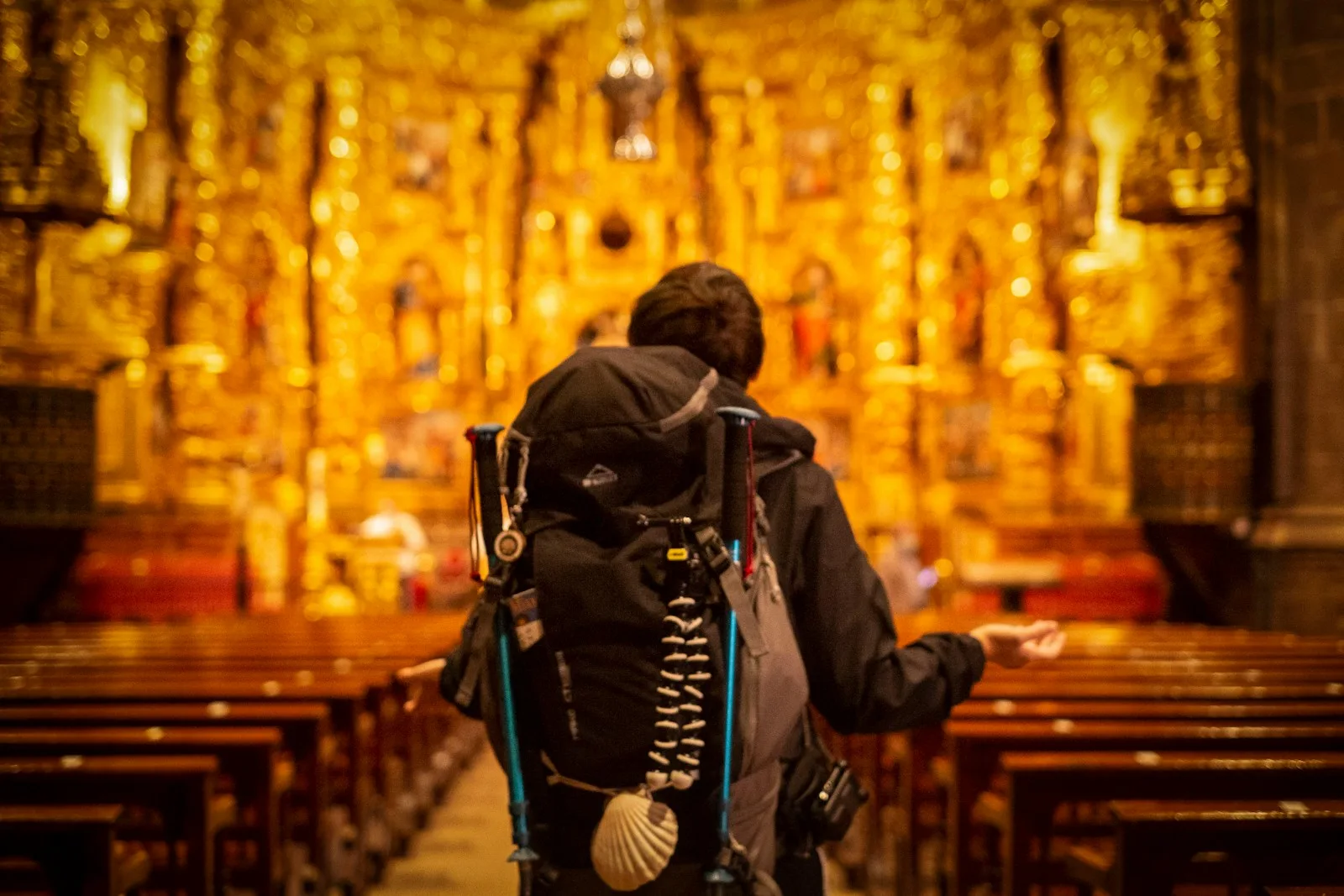
I woke to monks singing Gregorian chant.
Is that the most punk-rock way to begin a morning?
Probably not.
There was no distortion.
No attitude.
Nobody was smashing an instrument against the monastery wall.
Gregorian chant is about as far from my regular soundtrack as you can travel without leaving the planet.
Yet music has a way of slipping past our defenses.
It does not knock.
It does not ask whether the timing is convenient.
It simply walks in, puts a hand on your soul, and moves the furniture around.

As I lay in the half-dark listening to those voices travel through the ancient stone, something inside me settled.
For a few moments, I was not thinking about my sore legs, the weight of my pack, or how many kilometers waited ahead.
I simply listened.
Maybe Punk Was Never Only About the Genre
Perhaps it is about remaining open, awake, and undefended enough to let something genuine hit you— even when it arrives dressed in the least likely uniform.
Centuries-old monastic harmony?
It turns out that it slaps.
Ravens and Magpies Along the Camino
Once we started walking, the beauty arrived with feathers.
Ravens and magpies appeared along the route, which made them my favorite type of Camino company.
Corvids are the punks of the bird world: intelligent, noisy, mischievous, and completely unbothered by anyone’s opinion of them.
Regular readers already know that I practice ornithology mainly through vibes and flight patterns rather than careful consultation of a field guide.
The corvids seem to approve of this method.
There is an old rhyme about magpies that begins with one for sorrow and two for joy.
I lost count of them somewhere beyond joy and continued walking.
Call it superstition.
Call it pattern-seeking.
I will still take the omen.
An Absurd Number of Foals
Then came the baby horses.
It was foaling season, and apparently nobody had warned me to prepare emotionally.
Young foals stood beside their mothers throughout the green countryside.
Some grazed awkwardly.
Others tested their new legs while looking as though they had been assembled only minutes earlier without reading the instructions.
I genuinely lost count.

There is no clever spiritual lesson required here.
Sometimes the Camino simply gives you a hillside filled with newborn horses, and the only reasonable response is to stop and grin like an idiot.
They represented new life in its purest form— wobbly, curious, and completely indifferent to my sore quads or spiritual homework.
It is remarkably difficult to carry a heavy heart past a field of foals.
I tried.
It did not work.
Why Shorter Camino Stages Still Matter
Long-distance hiking can encourage the dangerous belief that bigger numbers automatically create better stories.
More kilometers.
More elevation.
More suffering.
But some of the most meaningful Camino reflections arrive on shorter days.
When you are not racing toward the next town, you notice more of what surrounds you.
Listening to the body is not weakness.
It is strategy.
The goal was not to win Day 3.
The goal was to continue walking tomorrow.
What to Expect Between Roncesvalles and Bizkarreta
The walk from Roncesvalles to Bizkarreta was much gentler than the brutal Pyrenean stages that came before it.
My legs were still carrying yesterday’s complaints.
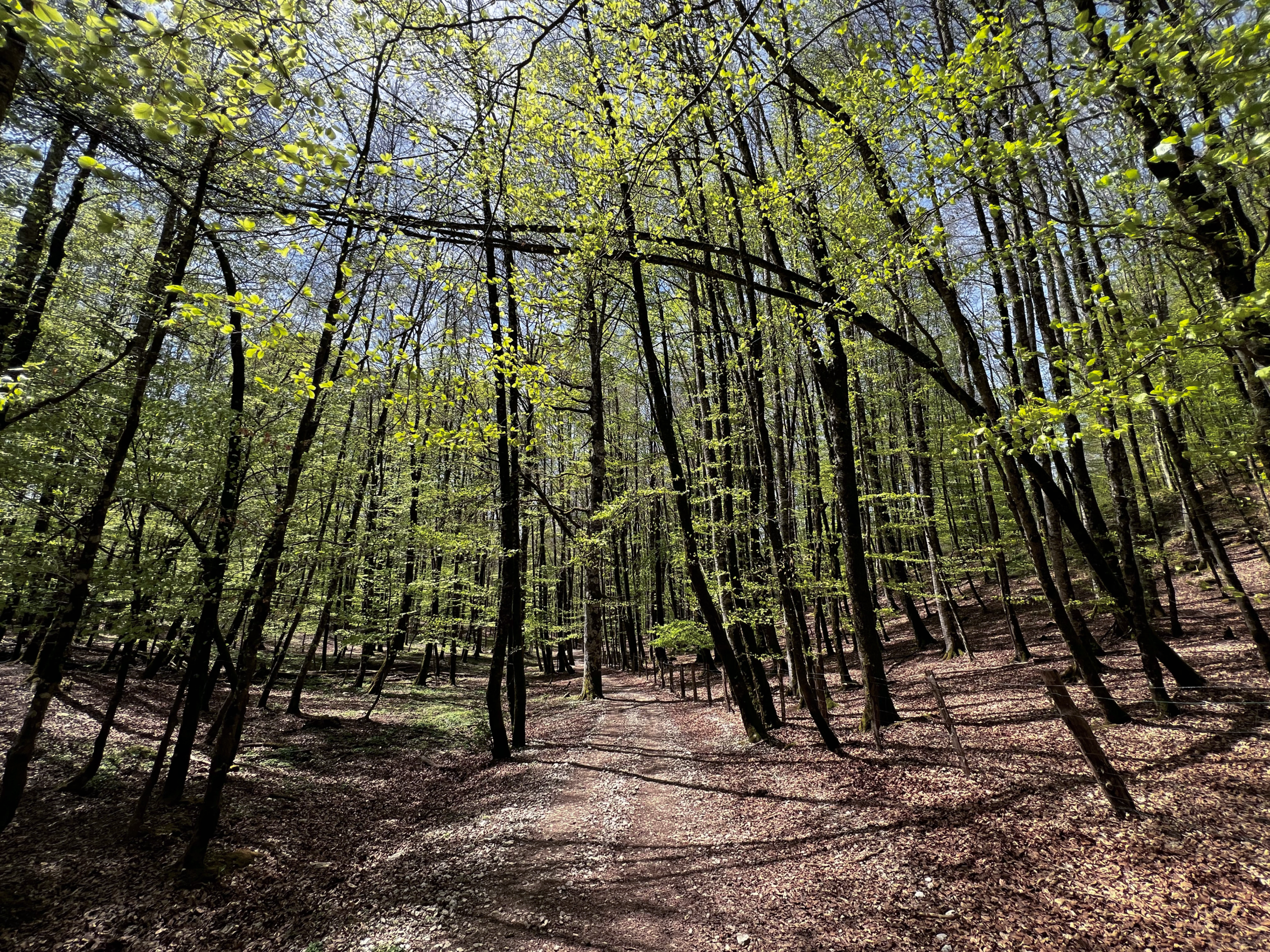
The route passed through a mixture of forest paths, rural tracks, paved village streets, and rolling countryside.
There were still descents to manage, although nothing felt as punishing as the drop into Roncesvalles.

The sunny weather made the stage especially enjoyable.
After days of clouds, steep climbs, and slippery trails, it felt good to walk beneath a clear sky and actually notice the landscape instead of staring at my boots while trying not to fall over.
The route passed through Burguete and Espinal before continuing toward Bizkarreta.
Those villages provided opportunities to stop for food, coffee, or water.
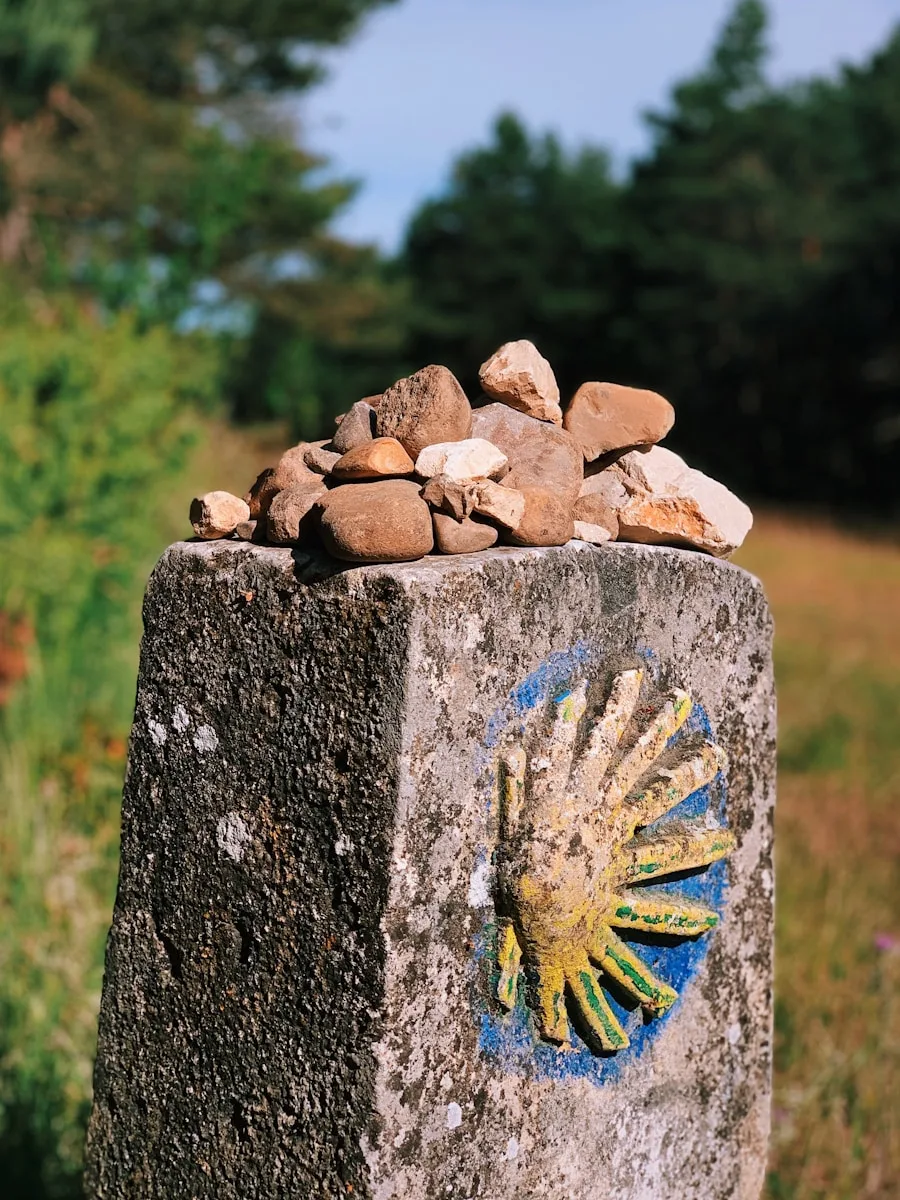
Navigation was generally straightforward because the Camino markers were easy to follow through the villages and wooded sections.
Trekking poles were still useful, particularly on downhill portions. My knees and quads had not forgotten the previous day’s descent.
Why We Stopped in Bizkarreta
Many Camino Francés itineraries continue from Roncesvalles all the way to Zubiri.
We chose to stop earlier in Bizkarreta instead.
After crossing the Pyrenees, forcing another long day on sore knees would have been a spectacularly stupid way to prove absolutely nothing.
The Camino Francés is not won during its opening weekend.
There is no prize for reaching Zubiri while limping like a wounded pirate.
Walking approximately 12 kilometers allowed us to stay in the rhythm of the Camino while giving our bodies time to adapt to carrying backpacks day after day.
We were still moving forward.
We simply stopped treating someone else’s suggested itinerary like a sacred commandment.
Casa Rural La Posada Nueva
We stayed in a private room at Casa Rural La Posada Nueva in Bizkarreta for €40.
After the demanding opening stages, having a quiet room and a little personal space felt like part of the recovery plan rather than an unnecessary luxury.
Traditional Camino stages are suggestions, not rules.
Daily distances can be adjusted around fitness, age, injuries, weather, accommodation availability, and how your body feels that morning.
Sometimes walking fewer kilometers
is not falling behind.
It is how you make sure you are still walking tomorrow.
What Camino Francés Day 3 Taught Me
Do not be afraid to shorten an early Camino Francés stage.
The climb across the Pyrenees gets most of the attention, but the long descent into Roncesvalles can punish your knees, quads, and feet before your body has fully adapted to walking every day with a backpack.
Stopping in Bizkarreta instead of continuing all the way to Zubiri allowed us to recover without losing the rhythm of the Camino.
We still packed our bags.
We still followed the yellow arrows.
We still moved forward.
The traditional Camino stages
are useful guides.
They are not sacred rules.
Sometimes the smartest way to reach Santiago is to walk fewer kilometers today so you can keep walking tomorrow.

Roncesvalles to Bizkarreta: Quick Answers
How far is Roncesvalles to Bizkarreta?
My Day 3 stage was approximately 12 kilometers, or about 7.5 miles.
How long did Roncesvalles to Bizkarreta take?
I allowed roughly four hours for the stage, depending on stops and walking pace.
Is Roncesvalles to Bizkarreta difficult?
I would describe it as easy to moderate, especially compared with the previous Pyrenees stages. The bigger issue for me was accumulated soreness from Days 1 and 2.
Which villages are between Roncesvalles and Bizkarreta?
The route passes through Burguete/Auritz and Espinal/Aurizberri before reaching Bizkarreta-Gerendiain.
Why stop in Bizkarreta instead of Zubiri?
We intentionally shortened the traditional Roncesvalles-to-Zubiri stage so our legs could recover after crossing the Pyrenees while we continued walking every day.
Where did you stay in Bizkarreta?
We stayed in a private room at Casa Rural La Posada Nueva. My recorded cost was €40.
What comes after Bizkarreta?
Day 4 continues from Bizkarreta to Zubiri, completing the remaining portion of the stage we deliberately split into two days.
Build a Camino That Fits Your Body
The journals tell you what happened to me. These guides can help you decide what makes sense for your own Camino.
Atypical Last Thoughts
I walked this stage as part of my 51-day journey from Saint-Jean-Pied-de-Port to Santiago de Compostela.
Day 3 of the Camino Francés was a gentler day, but it was not an empty one.
I began the morning with Gregorian chant echoing through Roncesvalles.
I walked beneath ravens and magpies.
I passed more newborn horses than I could count.
Somewhere between the sore muscles and shorter distance, I began to feel lighter.
The backpack still weighed the same.
Yet somehow,
I carried less.
That may be one of the Camino’s quietest lessons.
You do not always need to conquer another mountain to make progress.
Sometimes you simply need to slow down long enough to notice what is trying to reach you.
My body was sore.
My spirit was doing just fine.
Buen Camino.
Have you ever deliberately slowed down on a trip and discovered that you experienced more by doing less?
That does not mean it was easy. “Recovery” on the Camino simply means the mountain has stopped actively trying to kill you and has decided to let yesterday’s damage finish the job.
There were no screaming guitars, distorted amplifiers, or angry musicians questioning the entire structure of society. Instead, the voices of monks rolled through the stone walls of Roncesvalles while I slowly woke up and tried to negotiate peace with my legs.
After the rugged climbs and descents of the previous days, this was supposed to be an easier stage on the Camino Francés. I deliberately planned fewer kilometers because my body needed something resembling mercy.
Roncesvalles to Bizkarreta: Camino Francés Day 3
Monks, Magpies, Foals, and a Shorter Recovery Walk
Still, an easier day on the Camino is not necessarily an easy day. It simply means the trail is not as challenging and hope that yesterday’s damage won’t finish the job.
My muscles were sore from carrying my pack across the Pyrenees, but the descent into Roncesvalles had done most of the talking. The climbs get the dramatic photographs and triumphant stories. The descents quietly file the lawsuit.
My quads, knees, hamstrings, and lower back had apparently formed a committee overnight. Every member had a complaint.
This was the third stage of my complete Camino Francés journey. Start with my Camino Francés itinerary, or read about the Getting to St Jean Pied de Port.
| Stage detail | Information |
|---|---|
| Route | Roncesvalles to Bizkarreta-Gerendiain |
| Region | Navarra, Spain |
| Distance walked | ~ 12 km / 7.5 miles |
| Estimated walking time | ~ 4 hours |
| Elevation gain | ~ 148 meters / 486 feet |
| Elevation loss | ~ 314 meters / 1,030 feet |
| Highest elevation | ~ 780 meters / 2,559 feet |
| Lowest elevation | ~ 745 meters / 2,445 feet |
| Difficulty | Easy to moderate |
| Weather | Sunny |
| Terrain | Forest paths, rural tracks, paved village sections, and rolling hills |
| Communities along the route | Burguete/Auritz, Espinal/Aurizberri, and Bizkarreta-Gerendiain |
| Accommodation | Casa Rural La Posada Nueva, Bizkarreta |
| Room type | Private room |
| Accommodation cost | €40 |
| Main highlights | Gregorian chant in Roncesvalles, ravens, magpies, foals, forests, and a shorter recovery stage |
| Stage purpose | A lower-distance hiking day after the demanding Pyrenees crossing |
Rather than following the standard stage all the way to Zubiri, we stopped in Bizkarreta after approximately 12 kilometers. The shorter distance allowed us to keep moving while recovering from the demanding climb and descent across the Pyrenees. We stayed in a private room at Casa Rural La Posada Nueva for €40, giving our sore legs a little more peace than a crowded albergue might have offered.
- Roncesvalles to Bizkarreta
Monks, Magpies, and Foals
- Roncesvalles to Bizkarreta at a Glance
- Roncesvalles to Bizkarreta Route
- A Shorter Recovery Hike on the Camino Francés
- The Weight We Carry on the Camino
- Waking Up to Gregorian Chant in Roncesvalles
- Ravens and Magpies Along the Camino
- An Absurd Number of Foals
- Why Shorter Camino Stages Still Matter
- What to Expect Between Roncesvalles and Bizkarreta
- Why We Stopped in Bizkarreta
- What Camino Francés Day 3 Taught Me
- Roncesvalles to Bizkarreta: Quick Answers
- Build a Camino That Fits Your Body
- Atypical Last Thoughts
- Bizkarreta to Zubiri
- Roncesvalles to Bizkarreta: Camino Francés Day 3
- Waking Up to Gregorian Chant in Roncesvalles
- Why Shorter Camino Stages Still Matter
- Atypical Last Thoughts
- Hey, I’m Carter.
- Take the less-rehearsed road with me.
A Shorter Recovery Hike on the Camino Francés
Day 3 was not a complete rest day. It was more of a recovery hike—a shorter stage designed to keep us moving without piling another brutal distance onto already tired legs.
That distinction matters on the Camino Francés.
There is often pressure to walk farther, follow someone else’s itinerary, or reach the same destination as the faster pilgrims around you. However, the Camino does not hand out trophies for destroying your knees before reaching Pamplona.
Walking fewer kilometers gave my body time to recover while allowing me to remain connected to the daily rhythm of the trail.
Wake up. Pack the bag. Put one foot in front of the other.
Sometimes slowing down is not quitting. It is how you keep going.
The Weight We Carry on the Camino
The Camino is often described as a journey about letting go of burdens. Out here, that lesson becomes almost comically literal. Carry too much weight, and your body immediately lets you know.
Every unnecessary object inside your backpack begins to feel like a personal insult. You start questioning spare clothes, gadgets, toiletries, and every item you once considered essential.
Eventually, you realize the physical load is simply the spiritual one wearing a disguise.
We carry grudges, regrets, fears, expectations, and old versions of ourselves long after they have stopped being useful. At home, those burdens can remain hidden beneath routines and distractions.
On the Camino de Santiago, the trail has a way of dragging them into daylight.
The pain becomes a reminder. All the things we haul around on the inside eventually show up on the physical plane and ask to be set down. The Camino simply makes you feel them in your hamstrings instead of your chest. The challenge is learning to look beyond the burden. Past the soreness, past the complaining, and past the voice asking why you ever thought walking across Spain sounded like a reasonable vacation.
That is often where the beauty has been waiting the entire time.
Waking Up to Gregorian Chant in Roncesvalles
The most memorable moment of Camino Francés Day 3 happened before I had taken a single step. I woke to monks singing Gregorian chant.
Is that the most punk-rock way to begin a morning?
Probably not.
There was no distortion, no attitude, and nobody was smashing an instrument against the monastery wall. Gregorian chant is about as far from my regular soundtrack as you can travel without leaving the planet. Yet music has a way of slipping past our defenses.
It does not knock. It does not ask whether the timing is convenient. It simply walks in, puts a hand on your soul, and moves the furniture around.
As I lay in the half-dark listening to those voices travel through the ancient stone, something inside me settled. For a few moments, I was not thinking about my sore legs, the weight of my pack, or how many kilometers waited ahead.
I simply listened.
Perhaps punk rock was never entirely about the genre. Maybe it is about remaining open, awake, and undefended enough to let something genuine hit you—even when it arrives dressed in the least likely uniform.
Centuries-old monastic harmony?
It turns out that it slaps.
Ravens and Magpies Along the Camino
Once we started walking, the beauty arrived with feathers. Ravens and magpies appeared along the route, which made them my favorite type of Camino company. Corvids are the punks of the bird world: intelligent, noisy, mischievous, and completely unbothered by anyone’s opinion of them.
Regular readers already know that I practice ornithology mainly through vibes and flight patterns rather than careful consultation of a field guide.
The corvids seem to approve of this method. There is an old rhyme about magpies that begins, “one for sorrow, two for joy.” I lost count of them somewhere beyond joy and continued walking.
Every time I see magpies, I feel the same jolt of happiness and the stubborn belief that good fortune might be traveling down the road to meet me. Call it superstition. Call it pattern-seeking. Call it a tired pilgrim creating meaning out of bird sightings.
I will still take the omen.
An Absurd Number of Foals
Then came the baby horses.
It was foaling season, and apparently nobody had warned me to prepare emotionally. Young foals stood beside their mothers throughout the green countryside. Some grazed awkwardly. Others tested their new legs while looking as though they had been assembled only minutes earlier without reading the instructions.
I genuinely lost count.
There is no clever spiritual lesson required here.
Sometimes the Camino simply gives you a hillside filled with newborn horses, and the only reasonable response is to stop and grin like an idiot. They represented new life in its purest form—wobbly, curious, and completely indifferent to my sore quads or spiritual homework.
It is remarkably difficult to carry a heavy heart past a field of foals.
I tried.
It did not work.
Why Shorter Camino Stages Still Matter
Long-distance hiking can encourage the dangerous belief that bigger numbers automatically create better stories. More kilometers. More elevation. More suffering. However, some of the most meaningful Camino de Santiago reflections arrive on shorter days. When you are not racing toward the next town, you notice more of what surrounds you.
You hear the birds.
You stop for the horses.
You allow the morning’s music to remain with you.
A shorter Camino stage can also protect the body during the opening days of the route. Those first stages across the Pyrenees are demanding, especially when carrying a backpack and adjusting to walking day after day. Listening to the body is not weakness. It is strategy.
The goal was not to win Day 3. The goal was to continue walking tomorrow.
Why a Shorter Camino Stage?
We intentionally kept the distance lower after crossing the Pyrenees. The Camino Francés is not won during its opening weekend, and forcing a long day on already sore knees would have been a spectacularly stupid way to prove nothing. A shorter stage allowed us to remain in motion while giving our legs time to adapt to carrying backpacks every day.
Travelers planning the Camino Francés should not assume that every published stage must be followed exactly. Adjusting distances around your fitness, age, injuries, weather, and available accommodation can make the difference between continuing toward Santiago and ending the journey early.
What to Expect Between Roncesvalles and Bizkarreta
The walk from Roncesvalles to Bizkarreta was much gentler than the brutal Pyrenean stages that came before it, but my legs were still carrying yesterday’s complaints. The route passed through a mixture of forest paths, rural tracks, paved village streets, and rolling countryside. There were still descents to manage, although nothing felt as punishing as the drop into Roncesvalles.
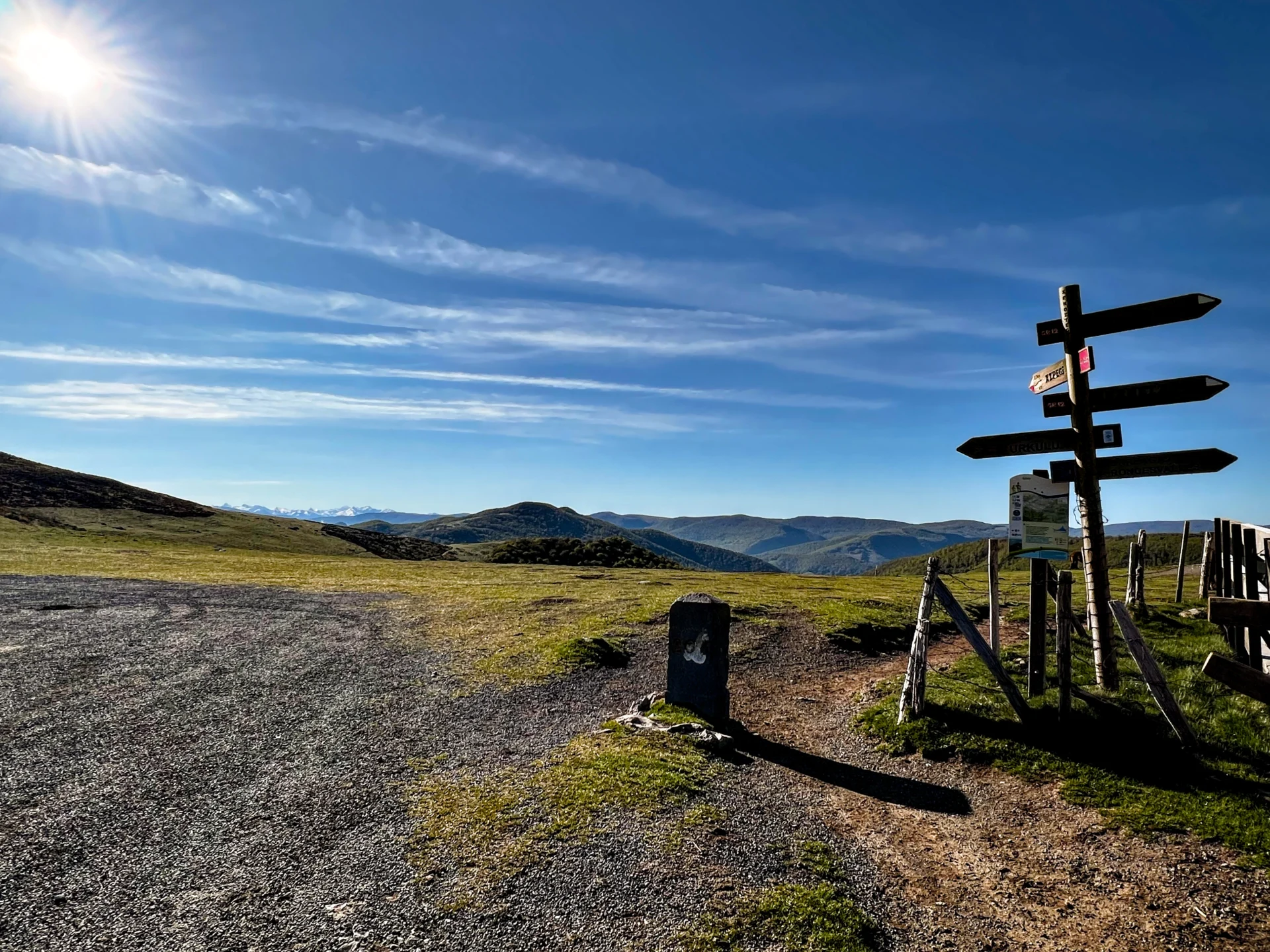
The sunny weather made the stage especially enjoyable. After days of clouds, steep climbs, and slippery trails, it felt good to walk beneath a clear sky and actually notice the landscape instead of staring at my boots while trying not to fall over.
The route passed through Burguete and Espinal before continuing toward Bizkarreta, which provided opportunities to stop for food, coffee, or water along the way. Navigation was generally straightforward because the Camino markers were easy to follow through the villages and wooded sections.
Trekking poles were still useful, particularly on the downhill portions. My knees and quads had not forgotten the previous day’s descent, and the poles helped reduce some of the impact. The shorter distance made this stage worthwhile because I could continue walking without pushing my body into another unnecessarily difficult day.
Why We Stopped in Bizkarreta
Many Camino Francés itineraries continue from Roncesvalles all the way to Zubiri. We chose to stop earlier in Bizkarreta instead.
After crossing the Pyrenees, forcing another long day on sore knees would have been a spectacularly stupid way to prove absolutely nothing. The Camino Francés is not won during its opening weekend, and there is no prize for reaching Zubiri while limping like a wounded pirate.
Walking approximately 12 kilometers allowed us to stay in the rhythm of the Camino while giving our bodies time to adapt to carrying backpacks day after day. We were still moving forward, but we were no longer treating someone else’s suggested itinerary like a sacred commandment.
We stayed in a private room at Casa Rural La Posada Nueva for €40. After the demanding opening stages, having a quiet room and a little personal space felt like part of the recovery plan rather than an unnecessary luxury.
Pilgrims planning the Camino Francés should remember that the traditional stages are suggestions, not rules. Daily distances can be adjusted around fitness, age, injuries, weather, accommodation availability, and how your body feels that morning.
Sometimes walking fewer kilometers is not falling behind.
It is how you make sure you are still walking tomorrow.
Plan Your Camino de Santiago
Continue preparing for your pilgrimage with these Camino guides:
What Day 3 Taught Me
Do not be afraid to shorten an early Camino Francés stage.
The climb across the Pyrenees gets most of the attention, but the long descent into Roncesvalles can punish your knees, quads, and feet before your body has fully adapted to walking every day with a backpack.
Stopping in Bizkarreta instead of continuing all the way to Zubiri allowed us to recover without losing the rhythm of the Camino. We still packed our bags, followed the yellow arrows, and moved forward—we simply chose a distance that made sense for our bodies.
The traditional Camino stages are useful guides, not sacred rules. Sometimes the smartest way to reach Santiago is to walk fewer kilometers today so you can keep walking tomorrow.
Atypical Last Thoughts
I walked this stage as part of my 51-day journey from Saint-Jean-Pied-de-Port to Santiago de Compostela. The observations and recommendations here are based on my own route, pace, weather, and experience carrying a full backpack.
Day 3 of the Camino Francés was a gentler day, but it was not an empty one. I began the morning with Gregorian chant echoing through Roncesvalles. I walked beneath ravens and magpies. I passed more newborn horses than I could count. Somewhere between the sore muscles and shorter distance, I began to feel lighter.
The backpack still weighed the same.
Yet somehow, I carried less.
That may be one of the Camino’s quietest lessons. You do not always need to conquer another mountain to make progress. Sometimes you simply need to slow down long enough to notice what is trying to reach you.
My body was sore.
My spirit was doing just fine.
Buen Camino.
What’s Next on the Camino?
Continue the Journey


Leave a Reply