

Explore Porto and Gaia at Your Own Pace
Written by Carter Lowry | Portugal resident and founder of Atypical Vagabond
Last updated: August 2026
Based on: My repeated visits to Porto from home in Coimbra and firsthand walks through the historic center, Ribeira, and Vila Nova de Gaia.
Porto is a city that rewards anyone willing to walk—but it also has a wicked sense of humor about hills.
A street that appears to be a harmless shortcut can turn into a granite staircase. A quiet alley can suddenly open onto the Douro River. You may leave your hotel planning to see one church and somehow return with 200 photographs of tiled façades, laundry hanging from balconies, and a bridge glowing in the late-afternoon sun.
This Porto walking itinerary connects the city’s historic landmarks with Ribeira, hidden medieval streets, riverfront scenery, and some of my favorite Porto photography locations. You can follow the shorter route in half a day or turn it into a full-day exploration that includes Vila Nova de Gaia.
If you need help planning the rest of your visit—including where to stay, what to eat, transportation, and day trips—start with my complete Porto travel guide.
Porto Walking Itinerary at a Glance

The map below shows both versions of this self-guided Porto walking tour. The orange half-day route begins at Jardim do Morro and finishes at São Bento Station. The blue full-day route starts at Mercado do Bolhão, crosses into Vila Nova de Gaia, and returns across the upper deck of the Luís I Bridge.
Use the map to understand the overall route, but keep your phone available for live directions. Construction, temporary closures, and Porto’s talent for hiding staircases can occasionally alter the most practical path.
| Route | Approximate distance | Walking time | Best for |
|---|---|---|---|
| Half-day Porto walk | 4–5 km | 3½–5 hours | Historic highlights, Ribeira and viewpoints |
| Full-day Porto walk | 8–9 km | 7–9 hours | A deeper route through Porto and Gaia |
These times include photography stops and short breaks but not lengthy attraction tours. Entering Clérigos Tower, Palácio da Bolsa, Porto Cathedral, or a port lodge will add time.
Before You Start Walking Through Porto
Half-day starting point: Take Metro Line D to Jardim do Morro in Vila Nova de Gaia. The route finishes near São Bento railway and Metro station.
Full-day starting point: Take the Metro to Bolhão and begin outside Mercado do Bolhão. The route finishes near São Bento or Batalha, depending on where you stop for dinner.
Best starting time: Begin around 8:30 or 9:00 in the morning for quieter streets and softer light.
What to wear: Choose shoes with reliable grip. Porto’s granite pavements can become slippery when wet.
What to bring: Carry water, sun protection, a light rain layer, and a charged phone. Porto weather occasionally likes to perform several seasons before lunch.
Accessibility: This itinerary includes steep slopes, uneven paving, and staircases. Travelers with limited mobility can replace the Barredo stairs with Rua de Mouzinho da Silveira and use the Guindais Funicular or other mechanized connections between the upper and lower city. Visit Portugal provides an accessible Porto itinerary with more detailed guidance.
Atypical tip: Do not try to complete every paid attraction along the route. Choose one or two interiors and let the streets supply the rest of the entertainment.
Half-Day Porto Walking Itinerary
This half-day Porto walking itinerary begins above the Douro at Jardim do Morro and finishes at São Bento Station. The route is designed to move gradually through Porto’s historic center without repeatedly climbing between the riverfront and upper city.
Starting on the Gaia side gives you one of Porto’s best opening views before you cross the upper deck of the Luís I Bridge and descend through the medieval city.
Start: Jardim do Morro, Vila Nova de Gaia.
Finish: São Bento Station, Porto.
Distance: Approximately 4–5 kilometers.
Walking time: Approximately 3½–5 hours with photography and coffee stops.
Difficulty: Moderate, with steep descents, stairs, uneven paving, and one unavoidable confrontation with Porto’s hills.
Route: Jardim do Morro → Luís-I-Bridge → Porto Cathedral → Pena Ventosa → Barredo → Ribeira → São Francisco and Palácio da Bolsa → Rua das Flores → Miradouro da Vitória → Clérigos → São Bento.
1. Begin at Jardim do Morro
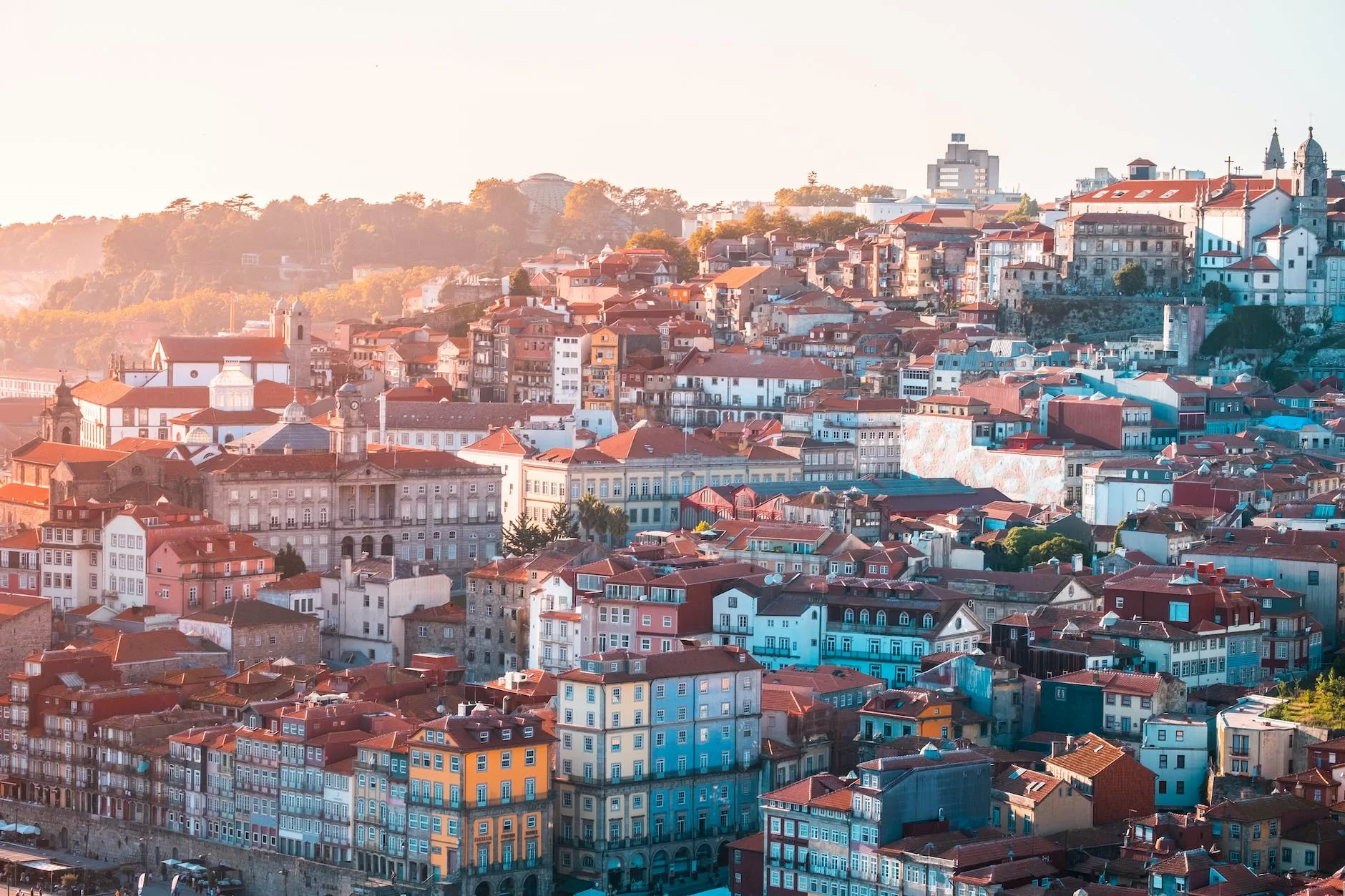
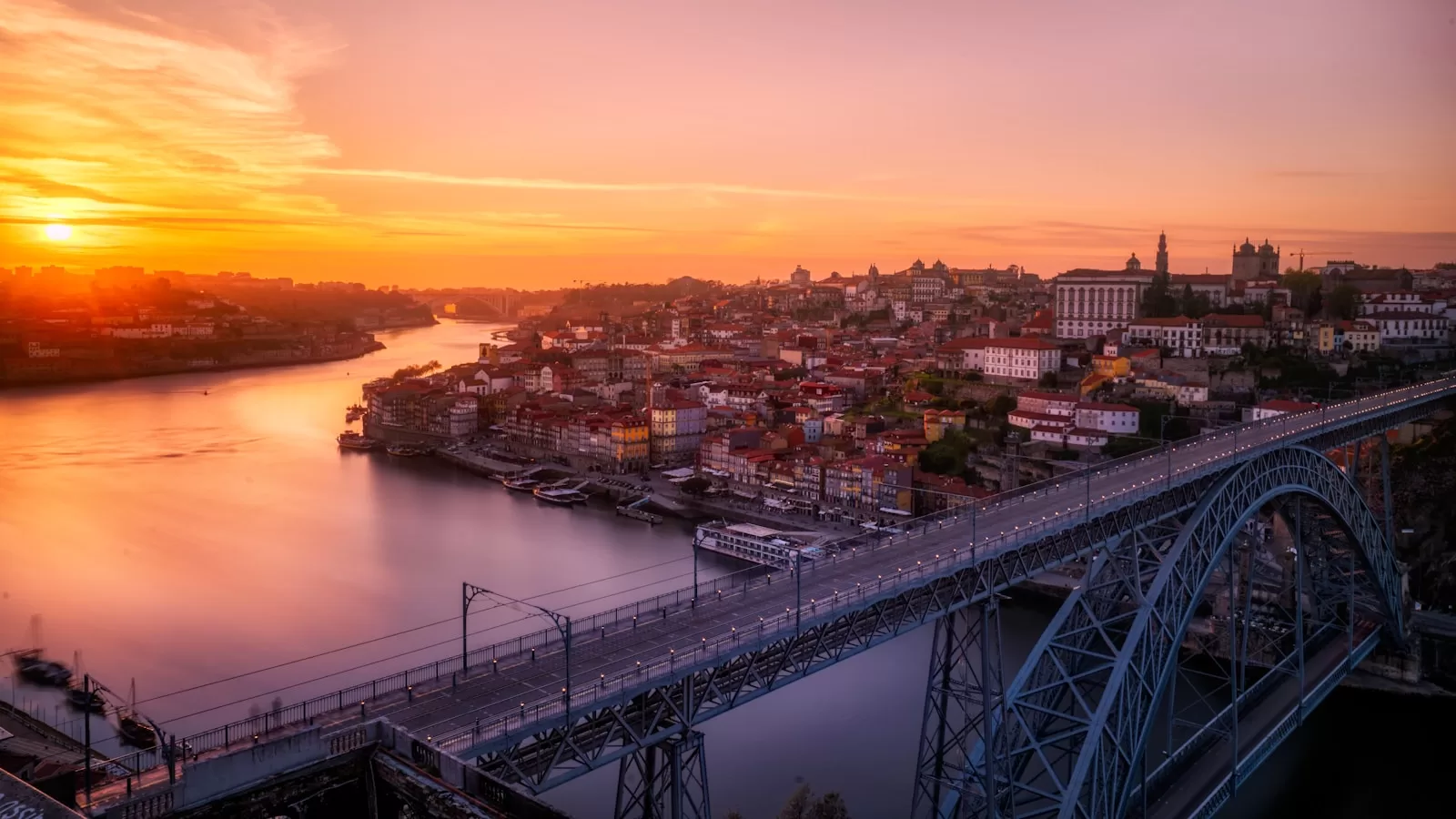
Jardim do Morro sits above the Gaia riverfront with Porto rising across the Douro. From here, the cathedral, Ribeira, bridge, and stacked historic buildings appear together in one enormous urban portrait.
The garden becomes crowded around sunset, while mornings provide more space and softer conditions for photography.
Suggested time: 15–20 minutes.
Photography tip: Walk toward the Serra do Pilar terrace for a broader view encompassing the riverfront and Luís I Bridge.
Continue walking: Leave the garden beside Jardim do Morro Metro station and follow the pedestrian entrance onto the upper deck of the Luís I Bridge.
2. Cross the Upper Deck of the Luís I Bridge
Suggested time: 15 minutes.
Photography tip: Morning light works beautifully across the Porto side. Late afternoon and sunset produce warmer views over the river.
Continue walking: After reaching the Porto side, continue straight toward Avenida Vimara Peres and follow signs for Sé do Porto.
The upper deck is not merely a way across the river. It is one of the defining experiences of this Porto walking itinerary.
The views stretch across RibeiraT the Gaia port lodges, and the hills wrapped around the Douro. Metro Line D also uses the upper deck, so remain within the pedestrian areas and pay attention while taking photographs.
Pause near the middle—but resist holding a full fashion shoot while everyone else is attempting to cross.
3. Visit Porto Cathedral and Its Terrace
After crossing the bridge, continue uphill toward Porto Cathedral, commonly called the Sé. Its fortress-like exterior reflects the cathedral’s Romanesque origins, while later Gothic and Baroque additions reveal how the building evolved alongside the city.
Even if you skip the interior, stop at the terrace for views across Porto’s rooftops, the Douro, and Vila Nova de Gaia. The cathedral also marks the beginning of the Portuguese Camino de Santiago for many pilgrims, so look for yellow arrows and Camino shells pointing north.
Suggested time: 20 minutes outside or approximately 45 minutes with the cathedral and cloisters.
Photography tip: Step toward the edge of the terrace to frame Porto’s layered rooftops against the river.
Continue walking: Leave the cathedral terrace toward Calçada de Vandoma, then follow the narrow lanes west into Largo da Pena Ventosa.
4. Wander Through Largo da Pena Ventosa
Suggested time: 15–20 minutes.
Photography tip: The square works best with a moderately wide lens that captures the surrounding façades without forcing you against somebody’s front door.
Continue walking: Leave the square through the downhill lanes leading toward Barredo and the river. Expect steps, uneven stone, and several opportunities to question your choice of footwear.
Only a few minutes from the cathedral, Largo da Pena Ventosa feels removed from Porto’s grand monuments. Pastel-colored buildings surround a small square reached through narrow medieval lanes.
This is where the itinerary should slow down. Look through open passages, notice the changing tiles and balconies, and allow yourself a few wrong turns. Porto often becomes more interesting when the route briefly stops behaving like a route.
People still live in these streets. Photograph the architecture respectfully and avoid treating residents, windows, and doorways as stage scenery.
5. Descend Through Barredo
Continue downhill through Barredo toward Ribeira. This is one of the steepest and most atmospheric portions of the Porto walking itinerary.
Stone staircases squeeze between tall houses while laundry, tiled façades, tiny shrines, and brief openings reveal the Douro below. Porto feels less like a collection of attractions here and more like a city that grew wherever the hillside allowed.
The polished granite can become slippery after rain. Take your time, use the handrails where available, and do not assume every staircase is as innocent as it appears.
Suggested time: 20-30 minutes.
Photography tip: Photograph uphill as well as down. Looking back often creates stronger compositions of the staircases, façades, and layers of the neighborhood.
Continue walking: Follow the descending lanes toward the river until you emerge near Praça da Ribeira.
Easier alternative: Return toward Porto Cathedral and use the Guindais Funicular, or descend along the gentler streets surrounding Rua de Mouzinho da Silveira.
6. Walk Along Ribeira
Suggested time: 30–45 minutes.
Photography tip: Early morning offers quieter streets and cleaner views. Around sunset, the river begins reflecting the lights from Porto and Vila Nova de Gaia.
Atypical tip: Ribeira is excellent for coffee and people-watching, but compare menus before choosing a riverfront restaurant. A Douro view occasionally arrives with its own enthusiastic pricing structure.
Continue walking: Follow Cais da Ribeira west along the river toward Igreja de São Francisco and Palácio da Bolsa.
The descent eventually releases you onto Porto’s famous riverfront.
Ribeira is busy, colorful, touristy, historic, and still worth every step. Walk beside the Douro, watch the traditional rabelo boats, and look back toward the iron arch of the Luís I Bridge.
Do not limit yourself to the promenade. Explore the smaller passages behind Praça da Ribeira, where the neighborhood’s texture becomes more apparent one street away from the restaurant terraces.
The descent eventually releases you onto Porto’s riverfront.
Ribeira is busy, colorful, touristy, historic, and still worth every step. Walk beside the Douro, watch the traditional rabelo boats, and look back toward the iron arch of the Luís I Bridge.
Rather than stopping immediately at the busiest restaurant terrace, explore the smaller passages behind Praça da Ribeira. The neighborhood’s character becomes more apparent one street away from the river.
7. Continue to São Francisco and Palácio da Bolsa
Follow the river west from Ribeira toward Igreja de São Francisco and Palácio da Bolsa.
São Francisco looks relatively restrained from outside, but its interior erupts into gilded Baroque decoration. Next door, Palácio da Bolsa reflects Porto’s commercial history, with the lavish Arab Room serving as its architectural showstopper.
Visiting both interiors can consume much of a half-day route. Choose one, admire the other from outside, and save the second for a longer Porto visit. Palácio da Bolsa uses scheduled guided visits, so check the current tour schedule before organizing your day around it.
Suggested time: 15–20 minutes outside or 60–90 minutes for one interior.
Photography tip: Use the surrounding square to capture the buildings with more breathing room than the narrow streets usually allow.
Continue walking: Leave the square toward Rua de Ferreira Borges, then begin climbing through Largo de São Domingos toward Rua das Flores.
8. Walk Up Rua das Flores
Suggested time: 20–30 minutes.
Photography tip: Look uphill for layered views of the façades and downhill for glimpses toward the lower city.
Continue walking: Before reaching São Bento, turn west through the Vitória neighborhood and climb toward Miradouro da Vitória.
Rua das Flores connects the lower historic district with the area surrounding São Bento. Its restored façades, cafés, small shops, musicians, and side streets make this a more enjoyable climb than some of Porto’s steeper alternatives.
Do not hurry through it. Look above the storefronts, where tiled walls, carved stone details, iron balconies, and narrow windows reveal more of the older city.
The street can become crowded during the middle of the day. If a section feels congested, slow down rather than fighting through it like you are attempting to board the last lifeboat.
9. Detour to Miradouro da Vitória
Before finishing the route, climb through the Vitória neighborhood to Miradouro da Vitória.
The viewpoint is less polished than Jardim do Morro, but that is part of its charm. From here, you can see Porto Cathedral, the Luís I Bridge, Vila Nova de Gaia, and uneven layers of terracotta roofs descending toward the Douro.
The viewpoint sits beside private property, so remain within the public viewing area and keep noise low.
Suggested time: 15-20 minutes.
Photography tip: A moderate zoom helps isolate the cathedral and bridge among the rooftops. A wider lens captures the dense layers of the historic center.
Continue walking: Return through Vitória and follow the streets uphill toward Clérigos Church and Tower.
10. See Clérigos Before Finishing at São Bento
Suggested time: 20–30 minutes without climbing Clérigos Tower or approximately one hour with the tower.
Photography tip: Visit São Bento between train arrivals when possible. The entrance hall briefly becomes easier to photograph before the next wave of passengers arrives.
Finish: The half-day route ends at São Bento Station. From here, you can take the Metro, catch a train, walk toward Avenida dos Aliados, or find dinner nearby.
Clérigos Tower rises above the historic center and serves as one of Porto’s most recognizable landmarks. It also makes an excellent reference point whenever the surrounding streets rearrange your sense of direction.
If time and your knees allow, climb the tower for panoramic views over Porto. The staircase contains more than 200 steps and narrows near the top, so this is not the moment to discover that enclosed spiral staircases are your mortal enemy.
After visiting Clérigos, walk downhill toward São Bento Station. Inside the station’s entrance hall, blue-and-white tile panels illustrate scenes from Portuguese history and life across northern Portugal.
São Bento is a fitting final stop: beautiful, central, and connected to Porto’s railway and Metro networks.
Full-Day Porto Walking Itinerary
This full-day Porto walking itinerary explores more of the upper city before descending through Ribeira, crossing the lower deck of the Luís I Bridge, and finishing with Porto’s finest views from Vila Nova de Gaia.
Start: Mercado do Bolhão, Porto.
Finish: São Bento or Batalha after returning across the upper bridge.
Distance: Approximately 8–9 kilometers.
Walking time: Approximately 7–9 hours, including lunch and photography stops.
Difficulty: Moderate to challenging, with steep climbs, descents, stairs, and uneven paving.
Route: Bolhão → Capela das Almas → Santa Catarina → Aliados → São Bento → Clérigos → Carmo → Cordoaria → Vitória → Rua das Flores → São Francisco → Ribeira → Gaia waterfront → Jardim do Morro → Serra do Pilar → Luís I Bridge → Porto Cathedral.
| Stage | Route | Suggested time |
|---|---|---|
| Upper Porto | Bolhão → Capela das Almas → Santa Catarina → Aliados → São Bento | 1½ hours |
| Clérigos district | Clérigos → Carmo → Cordoaria → Vitória | 1½–2 hours |
| Historic descent | Rua das Flores → São Francisco → Ribeira | 1–1½ hours |
| Lunch | Rua das Flores or Ribeira | Approximately 1 hour |
| Gaia riverfront | Lower bridge → Gaia promenade | 1–1½ hours |
| Final viewpoints | Jardim do Morro → Serra do Pilar → upper bridge | 1½–2 hours |
Morning: Bolhão to São Bento
Begin outside Mercado do Bolhão, where Porto’s food traditions unfold across produce stalls, flower stands, specialty shops, and casual places to eat.
Visit in the morning when the market is most active. You can grab coffee or a light snack here, but save the full meal for later unless you want to begin an eight-kilometer walk carrying the emotional weight of three pastries.
Suggested time: Approximately 1½ hours.
Photography tip: Capela das Almas is easier to photograph earlier in the morning, before Rua de Santa Catarina becomes crowded.
Continue walking: From São Bento, climb west toward Clérigos Church and Tower.
From Bolhão, walk to nearby Capela das Almas. Its exterior is covered with blue-and-white azulejos depicting scenes from the lives of Saint Francis of Assisi and Saint Catherine.
Continue along Rua de Santa Catarina before turning toward Avenida dos Aliados. Porto’s monumental central avenue provides a dramatic contrast with the medieval lanes you will encounter later.
Finish this stage at São Bento Station and step inside its tiled entrance hall.
Late Morning: Clérigos, Carmo and Vitória
Suggested time: Approximately 1½–2 hours, depending on whether you climb Clérigos Tower.
Photography tip: The tiled Igreja do Carmo façade usually photographs best from across the street, where a wider angle captures the entire wall.
Continue walking: Leave the viewpoint through the Vitória neighborhood and begin descending toward Rua das Flores.
From São Bento, climb toward Clérigos Tower. If you want to visit the tower, reserve enough time for its narrow staircase and more than 200 steps.
Continue to Igreja do Carmo and Igreja dos Carmelitas. They appear to form one enormous church, but they are separate buildings divided by one of Porto’s narrowest houses. The tiled side wall of Igreja do Carmo is one of the most recognizable photography locations in the city.
Walk through Jardim da Cordoaria before continuing toward Miradouro da Vitória. The garden provides a useful place to rest before the route begins descending toward the Douro.
At Miradouro da Vitória, pause to study the landscape ahead. Ribeira lies below, Vila Nova de Gaia rises across the river, and nearly everything appears connected by a hill your legs will eventually need to negotiate.
Historic Descent: Vitória to Ribeira
Suggested time: Approximately 1–1½ hours without an interior visit.
Photography tip: Turn around occasionally while descending. Porto’s sloping streets often create stronger compositions when photographed uphill.
Continue walking: Enter Ribeira and choose lunch along the riverfront or one or two streets inland.
From Miradouro da Vitória, descend through the Vitória neighborhood toward Rua das Flores.
The streets between the viewpoint and the river are quieter than Porto’s main sightseeing corridors. Look for tiled façades, small squares, weathered stone buildings, and glimpses of the Douro between the rooftops.
Follow Rua das Flores downhill toward Largo de São Domingos, then continue to Palácio da Bolsa and Igreja de São Francisco. If you did not enter either attraction during the half-day route, this is the best point to choose one for the full-day itinerary.
From São Francisco, continue east along the riverfront into Ribeira.
Lunch: Rua das Flores or Ribeira
Stop for lunch before crossing into Vila Nova de Gaia.
Ribeira offers river views and a lively atmosphere, but restaurants directly beside the Douro can be crowded and more expensive. Walking one or two streets inland usually provides a calmer meal and sometimes better value.
Choose something substantial enough to power the afternoon without requiring a recovery period. A francesinha is one of Porto’s signature dishes, but combining one with several more kilometers of hills is less lunch and more a personal endurance experiment.
Suggested time: Approximately one hour.
Atypical tip: Check menu prices before sitting down and avoid restaurants where someone aggressively recruits you from the pavement. Good food rarely needs to chase you down the street.
Continue walking: Return to the Ribeira waterfront and follow the river east toward the lower deck of the Luís I Bridge.
Early Afternoon: Ribeira and the Gaia Riverfront
Suggested time: Approximately 1–1½ hours without a lodge tour.
Photography tip: Walk west along the promenade and photograph back toward the bridge. This angle places the Luís I Bridge behind the Gaia waterfront and Porto’s hillside.
Continue walking: Return east toward the Gaia Cable Car station or begin climbing through the streets toward Jardim do Morro.
After lunch, walk east along Ribeira toward the lower deck of the Luís I Bridge.
Crossing the lower deck places you close to the river and provides a different perspective from the dramatic upper crossing. Look back toward Porto as the colorful Ribeira façades rise above the northern bank.
Once in Vila Nova de Gaia, turn west and follow the promenade past traditional rabelo boats, restaurant terraces, and historic port lodges. The Gaia waterfront offers some of the clearest views back toward Porto, especially once you move away from the bridge.
If you want to visit a port lodge, reserve one tour in advance and treat it as the full-day route’s major paid attraction. Attempting several tastings before the final climb can turn the rest of the itinerary into experimental theater.
You can still enjoy this section without drinking. The riverfront views, historic boats, architecture, cafés, and atmosphere provide plenty to explore independently of the wine lodges.
Late Afternoon: Jardim do Morro and Serra do Pilar
From the Gaia riverfront, reach Jardim do Morro using the Gaia Cable Car or walk uphill through Gaia’s steep streets.
The cable car saves time and leg power. Walking reveals more neighborhood details, although by this point Porto’s hills may have started feeling like a personal disagreement.
At Jardim do Morro, pause for views across the Douro before continuing uphill to Serra do Pilar. Its elevated terrace provides one of the broadest panoramas of the Luís I Bridge, Ribeira, Porto Cathedral, and the historic riverfront.experiment.
Suggested time: Approximately 1½–2 hours, including the climb and photography stops.
Photography tip: Serra do Pilar provides the wider panorama, while Jardim do Morro creates stronger foreground compositions with trees, people, and the bridge.
Continue walking: Return to Jardim do Morro and approach the upper deck of the Luís I Bridge.e river east toward the lower deck of the Luís I Bridge.
The viewpoint becomes crowded near sunset, so arrive early enough to find space without joining the annual competition for who can hold a phone highest above everybody else.
Finish Across the Upper Deck of the Luís I Bridge
Suggested time: Approximately 30–45 minutes from Jardim do Morro to São Bento.
Photography tip: Pause near the middle of the upper deck for the final river view, but keep the pedestrian path clear.
Finish: São Bento and Batalha both provide convenient access to central Porto transportation, food, and accommodation.
From São Bento, climb toward Clérigos Tower. If you want to Return to Jardim do Morro and cross the upper deck of the Luís I Bridge toward Porto.
The elevated crossing provides one final view over the Douro, Ribeira, and the Gaia waterfront you explored earlier. Metro Line D shares the upper deck, so remain inside the pedestrian areas and step aside before stopping for photographs.
On the Porto side, continue toward Porto Cathedral. If you followed the entire route, you have already covered enough ground to finish here without proving anything to anybody.
From the cathedral, choose one of two endings:
- Finish at São Bento: Walk downhill toward São Bento Station for railway and Metro connections.
- Finish at Batalha: Continue toward Praça da Batalha for restaurants, cafés, and access to the Guindais Funicular area.
If sunset is your priority, reverse the final crossing and finish at Jardim do Morro or Serra do Pilar instead. Both viewpoints are more rewarding at golden hour than an exhausted march back across the bridge merely to satisfy a line on an itinerary.
Best Porto Photography Stops Along the Route

Porto’s hills create excellent viewpoints, but some of the strongest photographs come from street level. Use this table to plan around the light without turning the entire walk into a military operation coordinated by the sun.
| Photography stop | Best for | Best light |
|---|---|---|
| Jardim do Morro | Wide views of Porto, the Douro, and the Luís I Bridge | Sunset |
| Serra do Pilar | Elevated panoramas of the bridge and historic center | Late afternoon and golden hour |
| Luís I Bridge | River views, architecture, rooftops, and passing Metro trains | Morning or golden hour |
| Porto Cathedral terrace | Layered rooftops, medieval streets, and Gaia | Morning |
| Barredo | Staircases, tiled façades, narrow alleys, and neighborhood details | Soft morning light |
| Ribeira | Rabelo boats, reflections, colorful buildings, and street life | Early morning or evening |
| Miradouro da Vitória | Porto Cathedral, the bridge, and layered rooftops | Late afternoon |
Atypical tip: Porto rewards patience more than equipment. Step away from the busiest viewpoints, photograph uphill as well as downhill, and look for smaller details between the famous landmarks.
Where to Shorten the Route
Porto can make four kilometers feel suspiciously ambitious. If your legs begin negotiating for better working conditions, shorten the walk in one of these places:
| Shortcut | What you skip | Best for |
|---|---|---|
| Take the Guindais Funicular | The steep climb between Ribeira and Batalha | Travelers avoiding stairs or slippery slopes |
| Skip Miradouro da Vitória | One uphill detour from Rua das Flores | Saving approximately 20–30 minutes |
| Skip the Clérigos climb | More than 200 tower steps | Protecting tired knees while still seeing the exterior |
| Take the Gaia Cable Car | The climb from the Gaia waterfront to Jardim do Morro | Saving energy for the upper bridge |
| Finish at Ribeira | Gaia and the final viewpoints | Turning the full-day route into a shorter historic-center walk |
| Choose one paid interior | Either São Francisco, Palácio da Bolsa, Clérigos, or a port lodge | Preventing attraction visits from consuming the entire day |
Fastest useful version: Follow the half-day route from Jardim do Morro to Ribeira, then walk up Rua das Flores to São Bento. This preserves the bridge, cathedral, medieval streets, and riverfront while removing the Clérigos and Miradouro da Vitória detours.
What This Porto Walking Itinerary Does Not Include
This route concentrates on Porto’s historic center and the Gaia riverfront. It intentionally excludes attractions that require a substantial detour or are better reached by public transportation.
The walking routes do not include:
- Casa da Música
- Serralves Museum and Park
- Foz do Douro
- Matosinhos
- Porto’s Atlantic beaches
- Estádio do Dragão
- The eastern bridges and Campanhã
Trying to force these places into the same walk would transform a practical itinerary into an urban endurance event.
Use my complete Porto travel guide to incorporate those neighborhoods into a longer visit, compare transportation options, choose accommodation, and plan additional days.
Atypical tip: Give Foz, Serralves, or Matosinhos a separate half-day. Each becomes more enjoyable once you stop treating it as an inconvenient extension of central Porto.
Frequently Asked Questions About Walking in Porto
Atypical Last Thoughts

Porto’s famous landmarks deserve their reputation, but they are not the entire city.
The most memorable parts of this walk often happen between them: a staircase disappearing beneath someone’s laundry, a glimpse of the Douro through a narrow passage, neighbors talking across opposite windows, or a tiled wall you nearly missed because you were staring at your phone.
Use this Porto walking itinerary as a route, not a set of marching orders. Stop when something catches your attention. Take the side street. Sit beside the river longer than planned. Porto does not reveal itself efficiently—and that may be its best quality.
If Porto is part of a longer journey, use these Portugal travel itineraries to connect the city with destinations elsewhere in the country. For accommodation, food, transportation, day trips, and longer itineraries, continue planning with my complete Porto travel guide.
Meet Carter

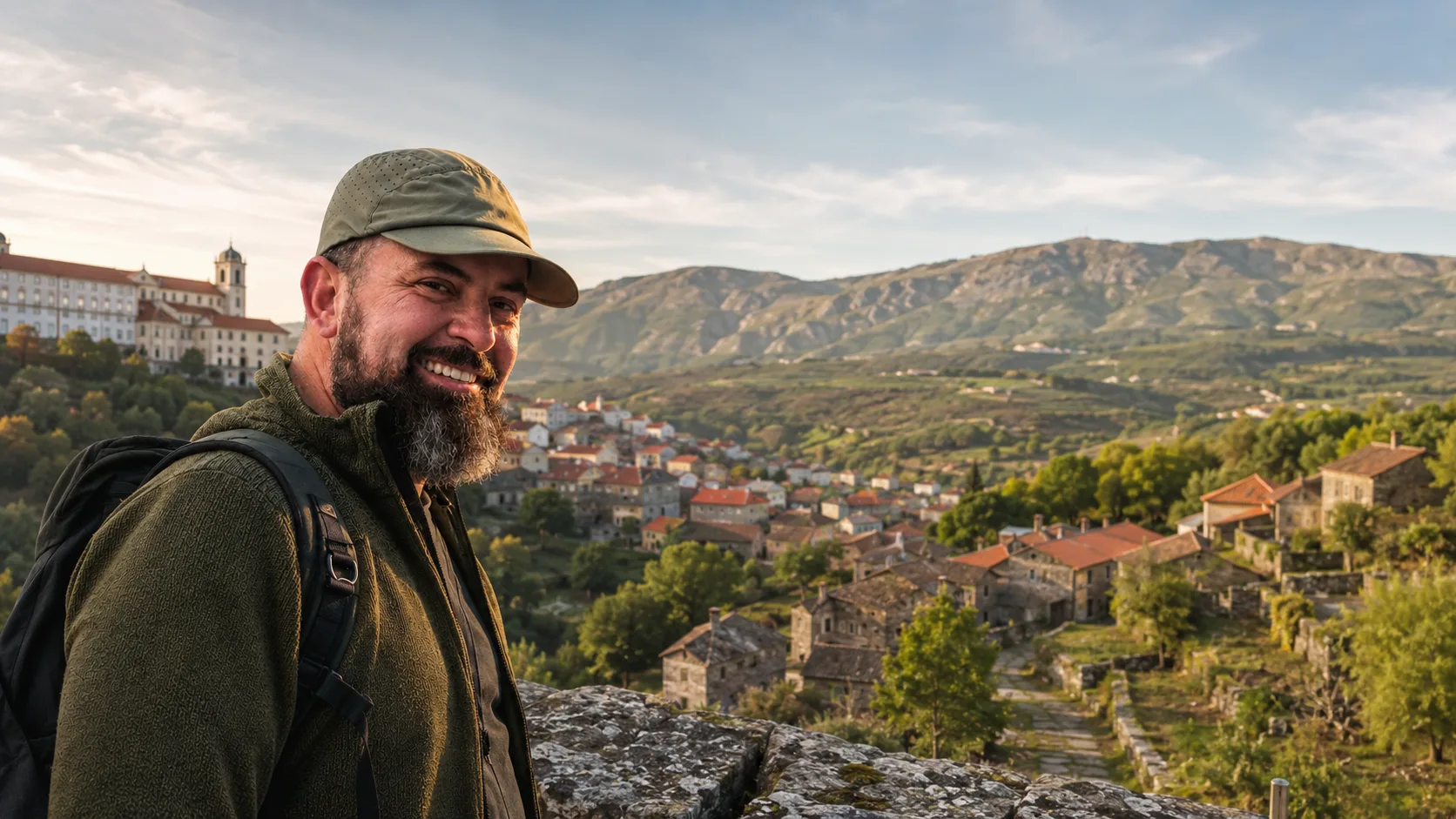
I’m Carter, an American traveler living in Portugal and the creator of Atypical Vagabond. After selling my technology business, I traded the conventional path for slow travel, life abroad, and a slightly unreasonable number of long walks across Europe. I share honest Portugal guides, Camino stories, digital nomad advice, and practical lessons to help you explore the world with greater confidence and purpose.
Subscribe
Looking for honest travel inspiration without the polished influencer nonsense?
Join the Atypical Vagabond newsletter for offbeat destination guides, Portugal travel tips, digital nomad lessons, slow travel stories, and the occasional reminder that the ordinary path is wildly overrated.
I share the victories, wrong turns, hidden gems, and real-life chaos that come with building a life around travel. No corporate fluff. No recycled bucket lists. Just useful advice, personal stories, and unconventional adventures designed to help you travel deeper, stay curious, and create your own damn route.
Subscribe and let’s reject the ordinary together.
Donations
Enjoying the stories, guides, videos, and occasional travel disaster here at Atypical Vagabond?
A small donation helps cover the real costs behind the adventures—from transportation and website hosting to camera gear, research, and enough coffee to keep the next guide moving.
There are no giant sponsors pulling the strings and no polished corporate travel machine hiding backstage. Your support helps me continue creating honest travel stories, practical Portugal guides, digital nomad advice, and unconventional adventures for travelers who prefer the road less rehearsed.
Every contribution helps keep Atypical Vagabond independent.
Fuel the next adventure through PayPal—and help me keep rejecting the ordinary.





Leave a Reply