
By Carter | Originally published March 5, 2024 | Updated July 2026
The Buracas do Casmilo are one of the most unusual day trips from Coimbra, Portugal. Hidden in the limestone hills of the Serra de Sicó, this quiet valley contains enormous openings left behind by a collapsed cave system. Short walking routes let visitors explore the cliffs without committing to an all-day mountain hike, while the surrounding villages reveal a rural side of Central Portugal that most first-time visitors never see.
I first visited Casmilo with my friend Omar, who wanted to show me the places around Coimbra that are difficult to discover without a car—or a local willing to lead you down suspiciously quiet country roads.
Coimbra hidden gems are not limited to secret courtyards, forgotten stairways, and tucked-away corners of the historic city. They are part of a much wider collection of Portugal hidden gems found beyond the country’s famous cities and heavily promoted attractions. Some of the most unusual places in the region sit beyond Coimbra’s familiar skyline, where university towers give way to limestone hills, olive groves, quiet villages, and roads that seem to have escaped the attention of the tourism machine.
That is where Casmilo enters the story.
Hidden in the Serra de Sicó landscape south of Coimbra, Casmilo is the kind of Portuguese village that rarely appears on first-time itineraries. There are no giant souvenir shops, polished tourist entrances, or crowds marching behind raised umbrellas.
Instead, there is a small rural community, an extraordinary geological landscape, and one of the most curious natural attractions in Central Portugal: the Buracas do Casmilo.
For travelers willing to leave Coimbra’s main attractions behind for a few hours, Casmilo offers something different. It is not simply another place to photograph. It is an invitation to slow down and see the quieter side of the Coimbra region.
Casmilo works particularly well for travelers who have already explored the city’s major attractions. My Coimbra Travel Guide can help you plan your time in the historic center before heading into the surrounding countryside.
- Watch My Journey Through Casmilo and Rural Coimbra
- How to Get to the Buracas do Casmilo from Coimbra
- My Coimbra Hidden Gems Road Trip
- Why Casmilo Belongs Among the Best Coimbra Hidden Gems
- Buracas do Casmilo: The Strange “Mouths of the Mountain”
- Exploring the Village of Casmilo
- Other Hidden Villages and Small Towns Near Casmilo
- A Coimbra Hidden Gems Day-Trip Route
- Practical Tips for Visiting Casmilo
- The Best Time to Visit Casmilo
- Are the Buracas do Casmilo Worth Visiting?
- Frequently Asked Questions About Casmilo
- Atypical Last Thoughts
Watch My Journey Through Casmilo and Rural Coimbra
Buracas do Casmilo at a Glance
| Casmilo trip detail | What travelers should know |
|---|---|
| Location | Serra de Sicó, near Condeixa-a-Nova |
| Best base | Coimbra |
| Best way to visit | Car |
| Main attraction | Buracas do Casmilo |
| Short trail | Approximately 3.5 km |
| Longer local trail | Approximately 6.5 km |
| Extended route | PR2 Rota de Sicó, nearly 25 km |
| Best for | Hiking, geology, photography and rural scenery |
| Terrain | Rocky, uneven and potentially slippery |
| Facilities | Limited near the valley |
| Suggested time | Half day or full day with nearby stops |
Casmilo is one of several rewarding excursions from the city. Compare it with castles, Roman ruins, mountain villages and coastal escapes in my guide to the best day trips from Coimbra.
The official Buracas do Casmilo walking routes and map describe a shorter route of approximately 3.5 kilometres and a longer local route of approximately 6.5 kilometres. A much longer route through the broader area also exists, but it should not be presented as though it is the only established Casmilo trail.
Experienced hikers can also follow the separate 23.5-kilometre PR2 Rota do Sicó through the wider Serra de Sicó landscape.
How to Get to the Buracas do Casmilo from Coimbra
Driving is the most practical way to reach the Buracas do Casmilo from Coimbra. The Casmilo trailhead is approximately 25 kilometres south of central Coimbra, and the journey normally takes around 30 to 35 minutes. Travel time can vary depending on where you begin in the city and which rural roads your navigation app chooses.
Instead of entering “Buracas do Casmilo” as your destination, navigate to the Parque de Merendas e Polidesportivo de Casmilo, the picnic and recreation area beside the village. This is the most convenient starting point for the shorter Casmilo walking routes and prevents Google Maps from leading you farther down an unpaved track than you intended.
Parking and Road Conditions
Ordinary passenger cars can reach the Casmilo picnic and recreation area. The approach through the village is paved, and visitors can normally find space near the picnic area and sports field before continuing on foot.
From the recreation area, the route toward the Buracas follows a marked gravel and dirt track. Some visitors drive farther along this road, but I recommend leaving the car near the picnic area. The track can be narrow, uneven, dusty in summer and muddy after heavy rain. Besides, walking the approach lets the landscape reveal itself gradually instead of arriving with your suspension making noises it did not make when you left Coimbra.
Casmilo is still a small residential village rather than a purpose-built tourist attraction. Park only in an obvious public space and avoid blocking doorways, farm entrances, narrow streets or access tracks used by local residents. The official Rota do Sicó guidance also asks walkers to respect private property and avoid disturbing the surrounding community.
Walking from the Casmilo Trailhead
The regional tourism authority describes two local walking options: a shorter route of approximately 3.5 kilometres and a longer route of approximately 6.5 kilometres. Both begin around Casmilo and pass through the limestone landscape surrounding the valley.
You can view the Buracas do Casmilo walking-trail map before beginning your walk.
Experienced hikers planning a much longer route can also download the official PR2 Rota do Sicó trail brochure and map. The complete circular route covers 23.5 kilometres and connects Casmilo with other geological and historical sites, including Conímbriga and the Rio de Mouros valley. It should not be confused with the shorter walks around the Buracas.
Visiting Casmilo Without a Car
Reaching the Buracas without a car is possible, but it requires more planning. Busway line 268 serves Casmilo on selected weekday journeys within the Condeixa-a-Nova network, but the limited timetable does not provide the flexibility most visitors will want for a hiking trip. Always check the current outbound and return schedules before relying on the bus.
For most travelers without a rental car, the simplest alternatives are a prearranged taxi, private transfer or guided hiking tour from Coimbra. Arrange your return transportation before leaving the city rather than assuming that a vehicle will be available in Casmilo when you finish walking
Check the current Busway line 268 timetable before leaving Coimbra, paying particular attention to the final return journey.
My Coimbra Hidden Gems Road Trip
I did not set out from Coimbra with a grand expedition plan, matching hiking gear, or a clipboard full of attractions. This was closer to a free afternoon, a car, a pair of decent shoes, and a willingness to follow the smaller roads to see what the hills were hiding.
Our first stop was Casmilo, about half an hour south of Coimbra. The change in scenery happened quickly. Coimbra’s university towers and tiled streets disappeared, replaced by limestone, rough tracks, olive trees, greenery, and enormous openings cut into the mountainside.
Casmilo did not feel like a commercial attraction. There was no ticket office, glowing visitor path, or souvenir shop selling cave-shaped refrigerator magnets. The landscape felt rugged, local, and largely left to get on with being strange.
After exploring Casmilo, we continued toward the windmills near Soure. The hills were open, the views stretched across the countryside, and the wind arrived with enough enthusiasm to turn a jacket into emergency sailing equipment.
We finished in Ançã, where some friends introduced me to local baked goods that were supposedly cakes. I remain unconvinced. One tasted like a slightly sweet Hawaiian roll, while another had a hint of cinnamon. Both were excellent with butter, but the question remains: cake, bread, pastry, or a full-blown Portuguese carbohydrate identity crisis?
That combination made the day memorable. Casmilo supplied the caves, Soure brought the wind, and Ançã delivered the bread-cake controversy. None of the stops involved giant attractions, but together they revealed the quieter side of the Coimbra region that I was hoping to find.
Exploring Beyond Coimbra with Omar
I first visited Casmilo because my buddy Omar wanted to show me parts of the Coimbra region that I would not normally be able to explore on my own. I did not have a car, and he knew that many of these rural places were difficult to reach without one. He also wanted to introduce me to his friend YuYu, turning the day into less of a planned sightseeing tour and more of a local road trip between friends.
The drive out of Coimbra was calm. Omar and I chatted as the city gradually disappeared behind us and the landscape opened up around the road.
What surprised me most was how much the countryside near Casmilo resembled a savannah. The open land, scattered trees, dry grasses, and broad views felt completely different from the tiled buildings, narrow streets, and university towers I was accustomed to seeing inside Coimbra.
That contrast was part of what made the trip memorable. We had not traveled very far, but the scenery made it feel as though we had entered an entirely different part of Portugal.
Casmilo was only one part of Omar’s plan. He was also determined to introduce me to one of his favorite local foods: the bola de Ançã, or Ançã bread. He spoke about it with the enthusiasm normally reserved for major monuments or life-changing discoveries, so naturally, I had to see what all the fuss was about.
Before reaching Ançã, we stopped in Soure, where I saw the traditional windmills up close. From a distance, windmills can look like decorative pieces scattered across the Portuguese countryside. Standing beside them gave me a much better appreciation of their size and their connection to the agricultural history of the region.
The day was not built around famous attractions or a rigid itinerary. It was about having a local friend open the door to places, landscapes, and foods that I probably would not have discovered otherwise. That is often where the most memorable travel experiences begin.
Why Casmilo Belongs Among the Best Coimbra Hidden Gems
Casmilo belongs to the parish of Furadouro in the municipality of Condeixa-a-Nova. This southeastern corner of the municipality is shaped by the rugged limestone terrain of the Serra de Sicó, a landscape that feels far removed from central Coimbra despite being close enough for a day trip. The landscape is one of many reasons travelers should look beyond Lisbon and Porto when exploring the region. My Central Portugal Guide covers more historic towns, natural attractions, and lesser-known places throughout this part of the country.
The parish includes Casmilo, Furadouro, Cadaval Grande, and Peixeiro, with agriculture and pastoral traditions still forming part of local life.
That rural setting is a large part of Casmilo’s appeal.
You are not visiting a village that has been rebuilt to resemble the past. Casmilo still feels like a living settlement rather than an open-air museum. Houses, stone walls, cultivated fields, farm buildings, and narrow roads all reflect the practical realities of life in the hills.
It is understated—and that is precisely the point.
Plenty of destinations call themselves hidden gems after appearing in twelve million social media posts. Casmilo has not reached that stage yet. The village remains overshadowed by better-known Coimbra day trips such as Conímbriga, Lousã, Buçaco, and Figueira da Foz.
Its greatest attraction, however, deserves far more attention.
Buracas do Casmilo: The Strange “Mouths of the Mountain”

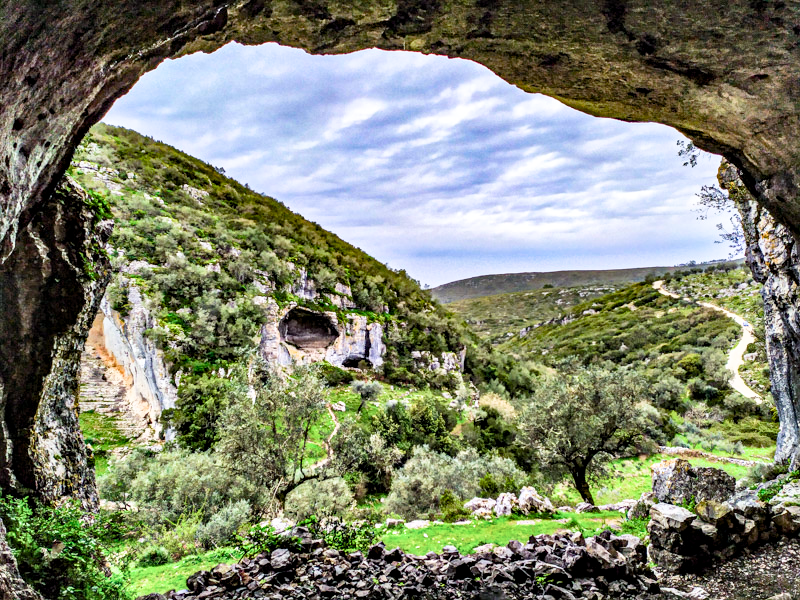
The Buracas do Casmilo are enormous openings carved into the limestone slopes near the village. Their scale is difficult to appreciate until you are standing beneath them, looking up at what appear to be giant mouths cut into the rock.
The formations are the exposed remnants of a former cave system. The central section of a subterranean passage collapsed, leaving portions of the cave’s side chambers visible in the surrounding cliffs. The geological process is known in Portuguese as incasão. The Região de Coimbra information about the geological formations explains that the openings vary considerably in size, with the largest exceeding ten metres in diameter. The central section of a subterranean passage collapsed, leaving portions of the cave’s side chambers visible in the surrounding cliffs. The geological process is known in Portuguese as incasão.
The result looks somewhere between a collapsed cavern, a natural amphitheater, and the abandoned headquarters of a particularly ambitious Bond villain.
The municipality describes Casmilo as containing the largest concentration of these formations in Portugal. Some of the cave entrances reach approximately ten meters, giving the valley its dramatic, almost prehistoric appearance. Local people sometimes refer to them as the bocas da serra, or “mouths of the mountain.”
Olive trees grow below the cliffs. Rough tracks cross the valley. Limestone breaks through the soil in sharp, pale formations. Depending on the season, the area may appear intensely green or dry and sun-bleached.
Either way, it does not look like the Portugal promoted on airport posters.
More Than a Photography Stop
The Buracas do Casmilo are popular with hikers, climbers, mountaineers and outdoor groups. According to the Condeixa-a-Nova municipal information about the Buracas do Casmilo, more than 60 climbing routes of varying difficulty have been identified around the formations, making the area one of Central Portugal’s notable climbing locations.
You do not need to climb anything to enjoy the valley. Walking below the cliffs is enough to appreciate the scale of the landscape, although the ground can be rocky and uneven.
This is not a manicured urban park. Wear shoes with decent grip and treat the terrain with respect.
Do You Need to Complete the Entire Hiking Route?
No.
The official PR2 Rota do Sicó route covers approximately 23.5 kilometres, takes an estimated six hours and 45 minutes, and includes around 950 metres of accumulated ascent. That is a proper hike rather than a casual wander after lunch.
Experienced hikers should download the official Rota do Sicó trail map before setting out. The mapped route connects Casmilo, the Buracas, Senhora do Círculo, the Rio de Mouros valley and Conímbriga.
Visitors can still explore the village and see the Buracas without completing the entire marked route.
The longer trail will appeal to experienced hikers who want to explore more of the Serra de Sicó. Everyone else can enjoy a shorter visit, take in the principal formations, and continue toward the surrounding villages.
Exploring the Village of Casmilo
It would be easy to rush through Casmilo, photograph the Buracas, and immediately leave.
That would also miss part of the experience.
Casmilo’s quiet streets show a version of Central Portugal that receives considerably less attention than Coimbra’s monumental architecture. The village is modest, agricultural, and shaped by the harsh limestone environment surrounding it.
There may not be a checklist of ten compulsory attractions. That does not mean there is nothing to see.
Walk slowly. Notice how the stone walls divide the land. Look at the relationship between the houses, farmland, and exposed limestone. Listen to how quiet the village becomes once the sound of your vehicle disappears.
Small Portuguese villages often reward observation rather than frantic activity.
They also require consideration. These are residential communities, not film sets. Avoid blocking roads or entrances, keep noise down, and ask before photographing local people or private property.
Traveling off the beaten path only works when visitors avoid trampling a new beaten path into existence.
Other Hidden Villages and Small Towns Near Casmilo
Casmilo can be the centerpiece of a wider day trip through the Serra de Sicó and southern Coimbra region. It is also one of the most unusual things to do near Coimbra for travelers interested in rural villages, geology, and places beyond the usual sightseeing circuit.
My journey continued through Soure and Ançã, but Casmilo can also be combined with several other worthwhile destinations in this part of Central Portugal. The following stops are additional itinerary ideas rather than places featured in my original video.
Furadouro
Furadouro is both the name of the parish and one of the small settlements near Casmilo. The area lies around seven kilometers from Condeixa-a-Nova and includes a collection of rural communities shaped by farming, livestock, and their isolated mountain setting.
Furadouro is not a destination filled with conventional attractions. It is valuable because it helps place Casmilo within the larger rural landscape.
Rather than thinking of the Buracas as an isolated geological oddity, passing through Furadouro reveals how people have adapted to the surrounding hills, narrow roads, and limestone terrain.
This is slow travel in its most literal form. Sometimes you have to slow down because the road leaves you very little choice.
Rabaçal
Rabaçal is one of the most rewarding stops to combine with Casmilo.
The village is associated with the Roman Villa of Rabaçal, an archaeological complex located around 12 kilometers south of Conímbriga. The villa once stood close to the Roman route connecting Olisipo, present-day Lisbon, with Bracara Augusta, present-day Braga. Archaeological work has uncovered residential, agricultural, and service areas, including an unusual octagonal central courtyard arrangement.
Rabaçal is also known for Queijo Rabaçal DOP, a protected cheese traditionally produced from a mixture of sheep and goat milk.
In other words, Rabaçal gives travelers two excellent reasons to stop: Roman archaeology and cheese.
History is educational. History accompanied by cheese is a proper travel strategy.
Penela
Penela is larger than Casmilo or Rabaçal, but it still feels pleasantly removed from Portugal’s busiest tourism corridors.
The town rises beneath Penela Castle, where medieval walls and towers overlook the surrounding countryside. I visited during its annual medieval celebration, an experience I share in my guide to Penela Castle and its Medieval Festival. Surviving sections of the fortress include elements from different periods, including outer walls dating primarily from the 14th and 15th centuries.
Penela works particularly well as the final stop of the day. After spending time among limestone cliffs and rural villages, the castle provides a more structured historical attraction and broad views over the region.
It also has more cafés and restaurants than the smaller settlements, making it a practical place to pause before returning to Coimbra.
Condeixa-a-Nova
Condeixa-a-Nova is the natural gateway to Casmilo.
Many travelers know the municipality because of the nearby Roman ruins at Conímbriga, but the Buracas do Casmilo, local museums, manor houses, and surrounding rural communities make it worth viewing as more than a quick refueling stop.
Condeixa can provide the practical side of the journey: food, fuel, supplies, and access to services before entering the smaller mountain communities.
A full itinerary could combine Conímbriga with Casmilo, although attempting to add every archaeological site, castle, village, café, and geological formation to one day may turn a slow-travel adventure into another frantic checklist.
Choose what interests you most and leave a reason to return.
A Coimbra Hidden Gems Day-Trip Route

The easiest way to explore this area is by car. Small rural settlements such as Casmilo do not have the same transport connections as Coimbra or Condeixa-a-Nova.
This route can also be incorporated into a longer journey through the country. Browse my Portugal itineraries for ideas on connecting Coimbra with other destinations in Central Portugal.
A comfortable route would look like this:
Coimbra → Condeixa-a-Nova → Casmilo → Buracas do Casmilo → Rabaçal → Penela → Coimbra
Begin in Coimbra and travel south toward Condeixa-a-Nova. Stop for coffee or supplies before continuing into the Serra de Sicó landscape.
Spend the morning walking around Casmilo and exploring the Buracas. Allow time to enjoy the valley rather than treating it as a five-minute photograph.
Continue toward Rabaçal for its rural atmosphere, Roman heritage, and local cheese. Finish in Penela, where you can explore the castle area, find something to eat, and enjoy the views before returning to Coimbra.
Travelers primarily interested in archaeology could add Conímbriga before or after Casmilo. Check the official Conímbriga visitor information for current opening hours, ticket information and temporary visitor updates before planning the day. Hikers may prefer to remove one of the towns and dedicate more time to the trails around Casmilo.
The route should fit your interests—not the demands of an imaginary sightseeing referee carrying a clipboard.

Portugal Itinerary Planner
Download the free Portugal Itinerary Planner PDF and build a trip that fits your travel style instead of following some bossy internet checklist. This printable guide includes flexible 3, 7, 10, and 14 day Portugal itinerary templates, home-base planning pages, rest-day prompts, no-car and road trip options, and the Atypical 1-4 Rule to help you […]
Practical Tips for Visiting Casmilo
Bring water, particularly during warmer weather. Rural facilities are limited once you leave the larger towns.
Wear sturdy footwear. Even a short visit involves uneven tracks, loose stones, and exposed limestone.
Download your map before entering the hills. Mobile coverage can be less dependable in rural and mountainous areas.
Do not climb into formations beyond your ability. The Buracas may look inviting, but steep rock and loose surfaces deserve caution.
Avoid blocking narrow roads or village entrances. Parking spaces are not designed for heavy tourism.
Leave no rubbish behind. The appeal of Casmilo depends heavily on its undeveloped landscape.
Check local conditions before attempting a long hike, especially after heavy rain or during periods of extreme summer heat.
The Best Time to Visit Casmilo
Spring is one of the most attractive seasons for exploring the Serra de Sicó. Vegetation brings more color to the limestone landscape, while temperatures are generally better suited to walking than during the height of summer. Turismo Centro de Portugal specifically highlights the Vale das Buracas as a distinctive spring destination.
Autumn can also be comfortable for exploring, particularly once the strongest summer heat has passed.
Summer visits are possible, but begin early, carry plenty of water, and expect exposed sections with limited shade.
Winter can give the cliffs a moodier appearance, although rain may make rocky paths slippery. This is one of those destinations where sensible footwear contributes more to the experience than a carefully coordinated travel outfit.
Are the Buracas do Casmilo Worth Visiting?
Yes—especially for travelers who enjoy nature, geology, hiking, photography, and small rural communities.
The Buracas are not a substitute for Coimbra’s historic center, the university, or Conímbriga. They provide a completely different experience.
That contrast is what makes them valuable.
One day you can stand inside Coimbra’s ornate university buildings. The next, you can walk beneath the remains of a collapsed cave system in a quiet limestone valley.
Central Portugal is good at changing the scenery without demanding that you travel an enormous distance.
Frequently Asked Questions About Casmilo
Atypical Last Thoughts

The phrase Coimbra hidden gems often produces lists of overlooked churches, small museums, and quiet corners within the city.
Those places have value, but the Coimbra region extends far beyond the university walls.
Casmilo reveals a rougher and quieter side of Central Portugal. The village, surrounding farmland, exposed limestone, and enormous Buracas create a landscape that feels almost disconnected from the more familiar version of Portugal.
Add Furadouro, Rabaçal, Penela, or Condeixa-a-Nova, and the journey becomes more than a stop at an unusual rock formation. It becomes a route through rural communities, Roman history, medieval defenses, local food, and the stubbornly unpolished countryside around Coimbra.
Casmilo will not entertain you with a packed schedule.
It asks you to walk, look, listen, and pay attention.
Sometimes that is exactly what a hidden gem should do.
Meet Carter

I’m Carter, an American traveler living in Portugal and the creator of Atypical Vagabond. After selling my technology business, I traded the conventional path for slow travel, life abroad, and a slightly unreasonable number of long walks across Europe. I share honest Portugal guides, Camino stories, digital nomad advice, and practical lessons to help you explore the world with greater confidence and purpose.
Subscribe
Looking for honest travel inspiration without the polished influencer nonsense?
Join the Atypical Vagabond newsletter for offbeat destination guides, Portugal travel tips, digital nomad lessons, slow travel stories, and the occasional reminder that the ordinary path is wildly overrated.
I share the victories, wrong turns, hidden gems, and real-life chaos that come with building a life around travel. No corporate fluff. No recycled bucket lists. Just useful advice, personal stories, and unconventional adventures designed to help you travel deeper, stay curious, and create your own damn route.
Subscribe and let’s reject the ordinary together.
Donations
Enjoying the stories, guides, videos, and occasional travel disaster here at Atypical Vagabond?
A small donation helps cover the real costs behind the adventures—from transportation and website hosting to camera gear, research, and enough coffee to keep the next guide moving.
There are no giant sponsors pulling the strings and no polished corporate travel machine hiding backstage. Your support helps me continue creating honest travel stories, practical Portugal guides, digital nomad advice, and unconventional adventures for travelers who prefer the road less rehearsed.
Every contribution helps keep Atypical Vagabond independent.
Fuel the next adventure through PayPal—and help me keep rejecting the ordinary.
One response to “Buracas do Casmilo: Hiking and Day Trip Guide from Coimbra”
-
[…] a journey of discovery through the charming small towns of the Coimbra region. From the picturesque streets of Casmilo to the historic villages nestled amidst rolling hills, each city offers its unique charm and […]







Leave a Reply