Walking to Puente la Reina on the Camino de Santiago began with a climb I had been staring at since the previous afternoon.
Alto del Perdón waited above Zariquiegui beneath a row of wind turbines, looking scenic, symbolic, and just steep enough to make me suspicious.
Sage and I had divided the traditional Pamplona-to-Puente la Reina stage into two shorter days. That meant Day 9 would cover only about 13 kilometers. On paper, it looked almost gentle.
The Camino enjoys this kind of misunderstanding.
First, it carried us into relentless wind and placed us beside the iron pilgrims on the Hill of Forgiveness. Then it dropped us down a steep trail of loose rock and reminded our knees that every inspiring summit comes with an invoice.
Climbs get the glory.
Descents keep the receipts.
By the end of the day, Sage and I would cross the medieval bridge that gives Puente la Reina its name. We would also reach the place where two major Camino routes become one.
Not bad for a “short” day.
Zariquiegui to Puente la Reina: Camino Francés Day 9
Climbing Alto del Perdón and Descending to Puente la Reina

| Stage detail | Information |
|---|---|
| Route | Zariquiegui → Alto del Perdón → Uterga → Muruzábal → Obanos → Puente la Reina |
| Region | Navarra, Spain |
| Distance walked | Approximately 13 km / 8 mi |
| Estimated walking time | Approximately 3.5–5 hours, depending on pace and stops |
| Difficulty | Moderate, with a demanding descent |
| Highest point | Alto del Perdón, approximately 770 m / 2,526 ft |
| Terrain | Exposed climb, rocky descent, village streets, and rolling agricultural tracks |
| Communities along the route | Zariquiegui, Uterga, Muruzábal, Obanos, and Puente la Reina |
| Optional detour | Santa María de Eunate from Muruzábal; allow roughly 6 additional km |
| Stage theme | Different roads can lead to the same place |
| Main highlights | Alto del Perdón, iron pilgrim monument, wind turbines, medieval villages, and Puente la Reina’s Romanesque bridge |
| Camino mood | Wind-blown reflection, careful footsteps, and knees filing formal complaints |
Distances vary slightly by app, accommodation, and detours. Treat these numbers as planning estimates, not commandments carved into a yellow trail marker.
This was Day 9 of my complete Camino Francés journey from Saint-Jean-Pied-de-Port to Santiago de Compostela.
You can read the previous entry here:
← Day 8: Pamplona to Zariquiegui
Or begin with my complete Camino Francés itinerary if you want to follow the entire glorious mess from the Pyrenees to Santiago.
Leaving Zariquiegui Beneath the Wind Turbines

Zariquiegui had been the right place to stop.
The previous day, Sage and I walked about 11 kilometers from Pamplona and slept directly beneath Alto del Perdón. Instead of adding the climb and descent to an already longer day, we let the hill wait until morning.
It was still there when we woke up.
Apparently, forgiveness does not wander off during the night simply because you would prefer a flatter itinerary.
The trail leaves Zariquiegui and begins climbing almost immediately. The ascent to the ridge is only about 2.3 kilometers, but it is exposed and steady. The turbines that had looked like tidy little shapes from a distance grew enormous above us.
Their blades moved in slow arcs with a sound like the sky breathing.
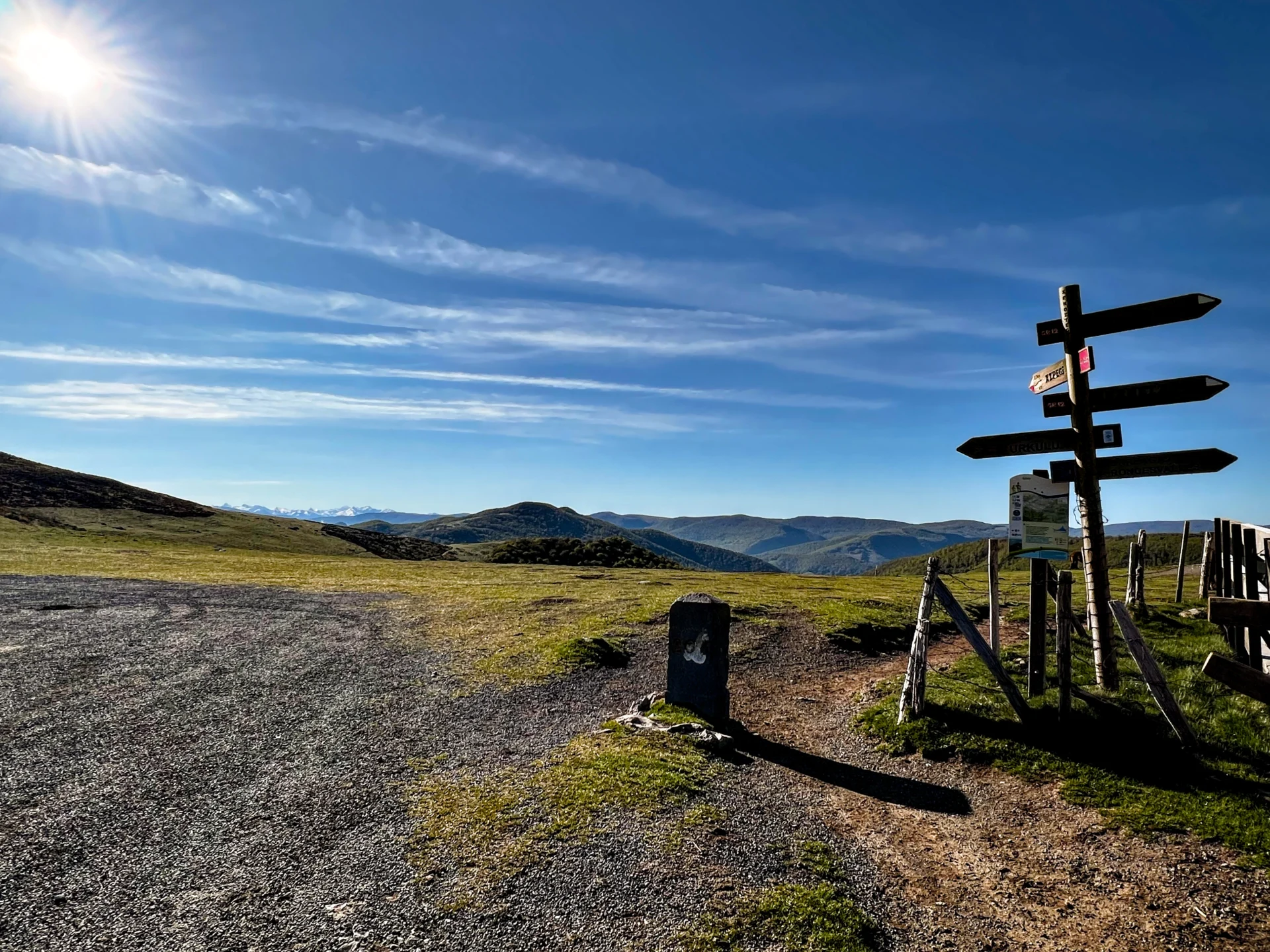
The higher we climbed, the farther the landscape opened behind us. Pamplona’s basin stretched back toward the east. Ahead, the western side of the ridge remained hidden until we reached the top.
There was no gentle transition. One moment, we were climbing with the slope in front of our faces. Then the land dropped away on both sides, and Navarra seemed to unfold all at once.
That is the trick Alto del Perdón plays.
It makes you work for the view, then gives you more horizon than you know what to do with.
The Hill of Forgiveness (Alto del Perdón)
Alto del Perdón means the Hill of Forgiveness, which feels like exactly the sort of name the Camino would give a windy climb.
Of course forgiveness is uphill.
Of course it is exposed.
Of course there is no spiritual escalator beside the trail.
You carry everything to the top yourself: your backpack, your sore feet, your old resentments, and whatever snacks survived breakfast.
Near Zariquiegui, the Camino also passes the Fuente de la Reniega, or Fountain of Denial. According to the legend, the devil offered water to a thirsty pilgrim if he would renounce his faith. The pilgrim refused, the devil disappeared, and a spring emerged.
Classic Camino.
Even the water comes with a moral dilemma.
Whether you accept the legend literally matters less than what it adds to the landscape. The Camino turns hills, fountains, bridges, and villages into containers for human questions.
What will you surrender when you are tired?
What will you keep carrying?
Who are you willing to forgive?
And how long can you remain spiritually composed before hunger turns you into a goblin?
These are the great mysteries of pilgrimage.
Standing With the Iron Pilgrims

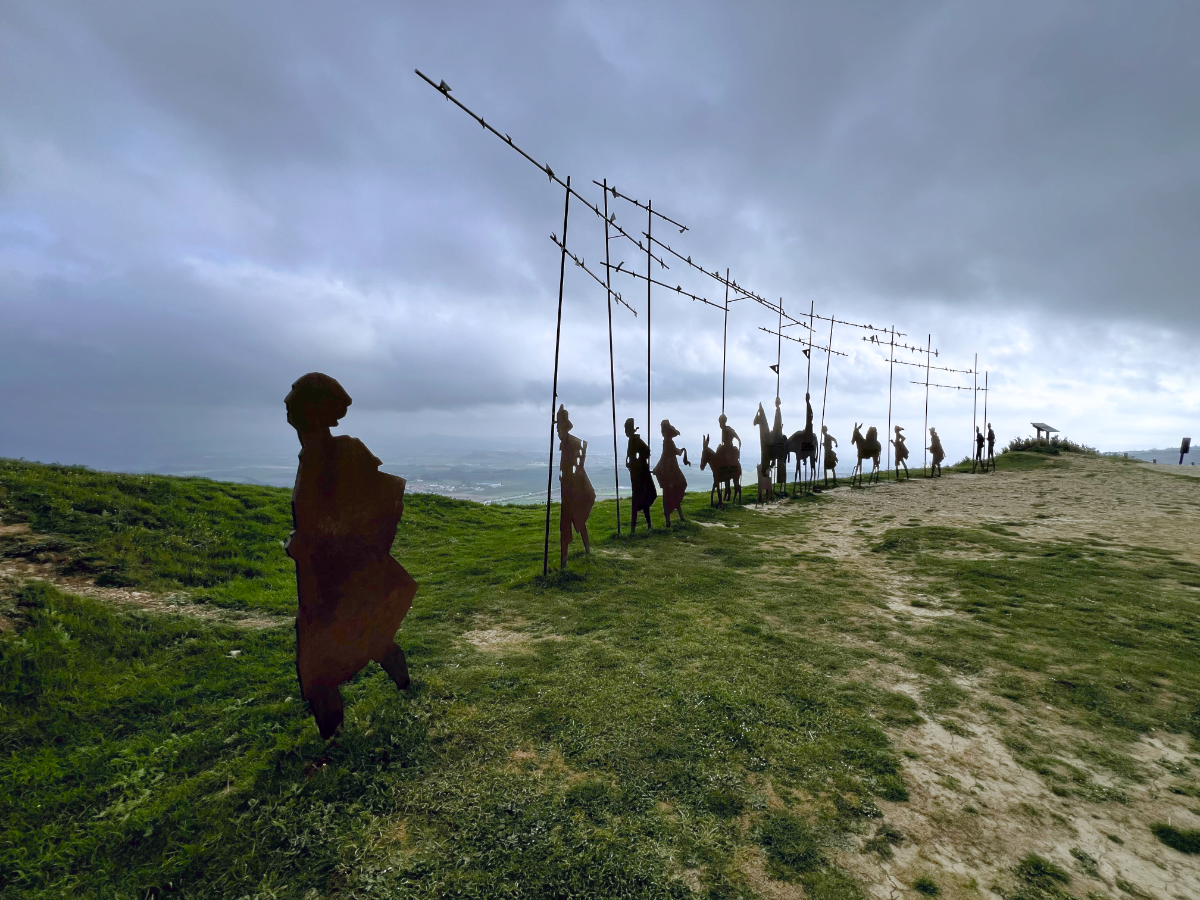
At the top of Alto del Perdón, a line of metal pilgrims leans permanently into the wind.
Some walk on foot. Others ride on horseback. Together, they form one of the most recognizable monuments on the Camino Francés.
The inscription reads:
Donde se cruza el camino del viento con el de las estrellas.
Where the path of the wind crosses the path of the stars.
That line captures the Camino better than most guidebooks ever could.
You are walking a physical trail through mud, villages, wheat fields, city streets, and loose stone. At the same time, you are moving through something older and less measurable.
Wind and stars.
Body and spirit.
Blisters and wonder.
Laundry and existential crisis.
The Camino refuses to separate the practical from the poetic.
I stood beside the iron pilgrims for a while, leaning into the same relentless wind. The turbines turned their enormous arcs above us. Pamplona’s valley lay behind. Another valley opened ahead.
I let the wind do whatever wind does to you at a place called the Hill of Forgiveness.
Then I tightened my pack and looked down the other side.
The Camino was about to collect its payment.
Practical Tips for Alto del Perdón
- Carry water and a snack from Zariquiegui rather than depending on a seasonal vendor at the summit.
- Secure loose hats and pack covers because the ridge can be extremely windy.
- Put on a layer before standing around if sweat and wind have started cooling you.
- Take time for the view, but keep enough energy and concentration for the descent.
- Have trekking poles ready before beginning the steepest section.
The Descent Nobody Romanticizes

According to the official Visit Navarra route information, Alto del Perdón rises to approximately 770 meters above sea level.
The photographs from Alto del Perdón usually show the iron pilgrims, the wide landscape, and someone looking spiritually transformed in flattering light.
They rarely show that same person ten minutes later, staring at a slope of loose stones while both knees reconsider the terms of their employment.
The descent toward Uterga is steep, broad, and covered with rocks that move as soon as you trust them. In dry conditions, they roll underfoot. In wet conditions, the trail can become slick. Either way, the path demands attention.
This was the hardest part of our day.
The climb asked for lungs. The descent asked for balance, patience, and joints willing to negotiate.
Every step required a small decision. Where does the next foot go? Is that stone stable? Can I slow down without the backpack trying to continue to Santiago without me?
There is a temptation to rush downhill because gravity makes speed feel easy. It is not. A fast descent transfers the work from your lungs to your knees, ankles, and concentration.
We moved carefully.
The Camino had just given us a soaring summit moment and then immediately made us pay for it on the way down.
I was beginning to sense a theme.
How to Handle the Alto del Perdón Descent
- Shorten your stride and keep your weight centered over your feet.
- Plant each trekking pole before committing your full weight.
- Leave room between yourself and the pilgrim ahead.
- Step off the clearest line when stopping so others can pass safely.
- Take a break before your legs begin shaking, not after.
- Do not race to Uterga. There is no podium waiting beside the café.
If knee pain or balance problems make this type of descent unsafe, consider arranging backpack transport for the stage. Your pilgrim credentials will survive. More importantly, so might your kneecaps.
Uterga: Coffee After the Rocks
Uterga is the first village after the descent and the natural place to let your legs stop shouting.
Depending on the season and time of day, pilgrims may find food, drinks, accommodation, and other services here. Do not build an emergency plan around one café always being open, but when something is available, Uterga feels like a small act of mercy.
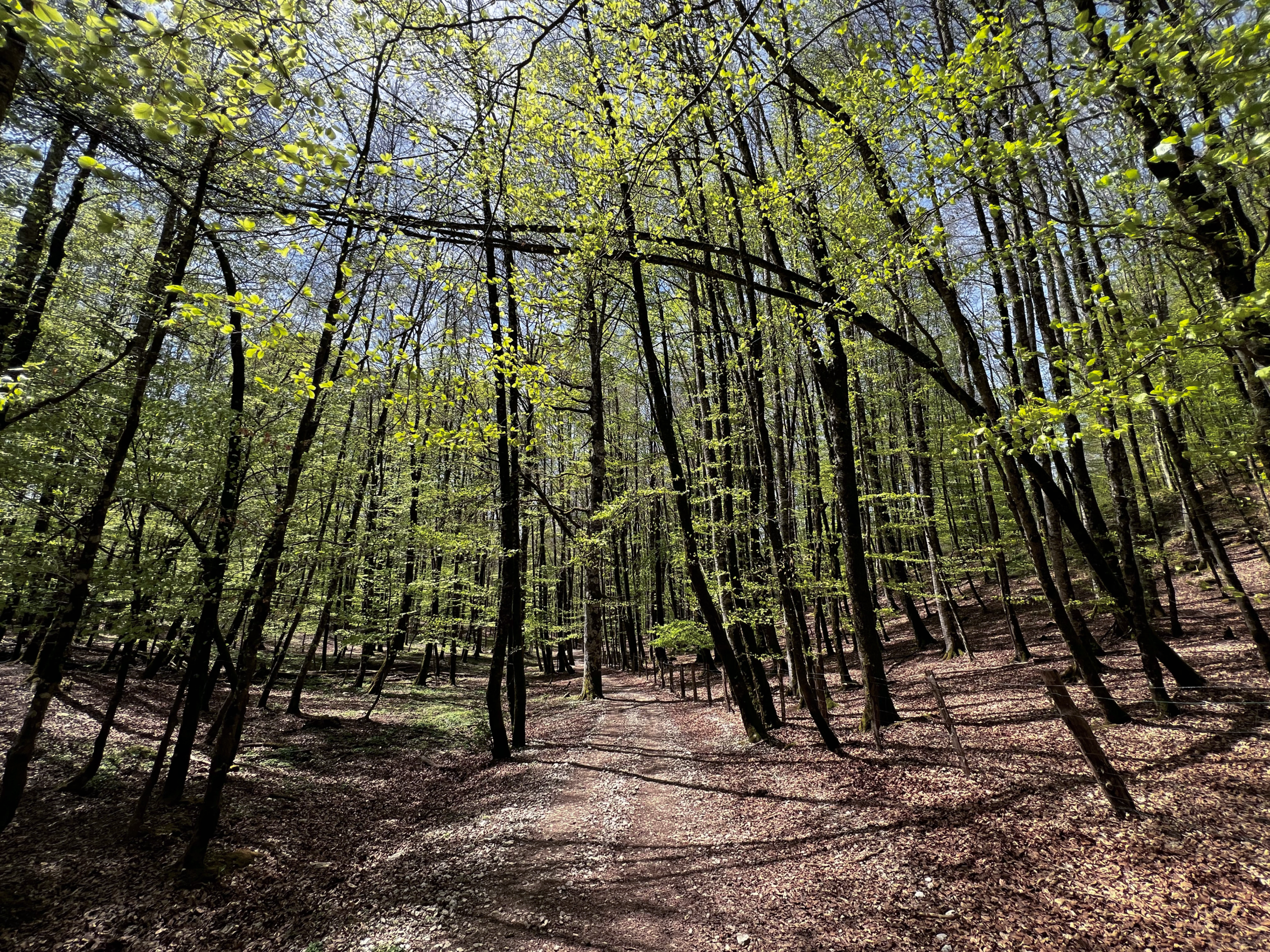
The route becomes gentler after the worst of the rocks. Fields replace the exposed ridge. Villages appear at more forgiving intervals. Your feet settle back into a rhythm that does not require solving a geological puzzle with every step.
Refill water when possible. Eat something. Check your feet.
Then continue toward Muruzábal.
Muruzábal and the Eunate Decision
The Camino from Uterga to Muruzábal is calmer, which gives your body time to realize what just happened on the descent.
Muruzábal also presents a choice.
Pilgrims can continue directly toward Obanos or take a detour to the Romanesque Church of Santa María de Eunate. The octagonal church and surrounding arcade make it one of Navarra’s most distinctive Camino landmarks.
The detour adds roughly 6 kilometers, depending on the precise route used.
Six kilometers sounds modest while sitting at home with a map and a beverage. It can feel substantially more philosophical after Alto del Perdón.
Decide before the stage if Eunate is a priority. Consider your legs, water, daylight, weather, and check-in plans. Continuing directly to Obanos does not make your Camino less authentic. Taking the detour does not award bonus holiness.
The trail gives you options.
Your body gets a vote.
Obanos: Where Separate Roads Draw Together
From Muruzábal, the route crosses rolling agricultural land toward Obanos.
This area marks one of the Camino’s great convergences. The route Sage and I had followed from Saint-Jean-Pied-de-Port, Roncesvalles, and Pamplona draws together with the Camino Aragonés arriving through Sangüesa.
Two streams of pilgrims approach by different Pyrenean crossings.
Two sets of villages.
Two collections of blisters, private reasons, and questionable backpack decisions.
Then the roads become one.
The exact point is described in different ways around Obanos and Puente la Reina. On foot, the boundary matters less than the experience. New pilgrims appear. Separate histories begin sharing the same yellow arrows west.
I loved the idea before we even reached the bridge.
You can spend days believing you are walking your own private journey, only for the Camino to show that others have been heading toward the same place through a slightly different door.
Arriving in Puente la Reina on the Camino de Santiago
Puente la Reina does not treat the Camino as a decorative footnote.
The pilgrimage shaped the town.
The marked route enters near the Church of the Crucifix and continues along Calle Mayor, the long historic street running through the old center. Stone façades, churches, balconies, cafés, albergues, residents, and tired walkers all share the same corridor.
Then, at the western edge of town, the bridge appears.
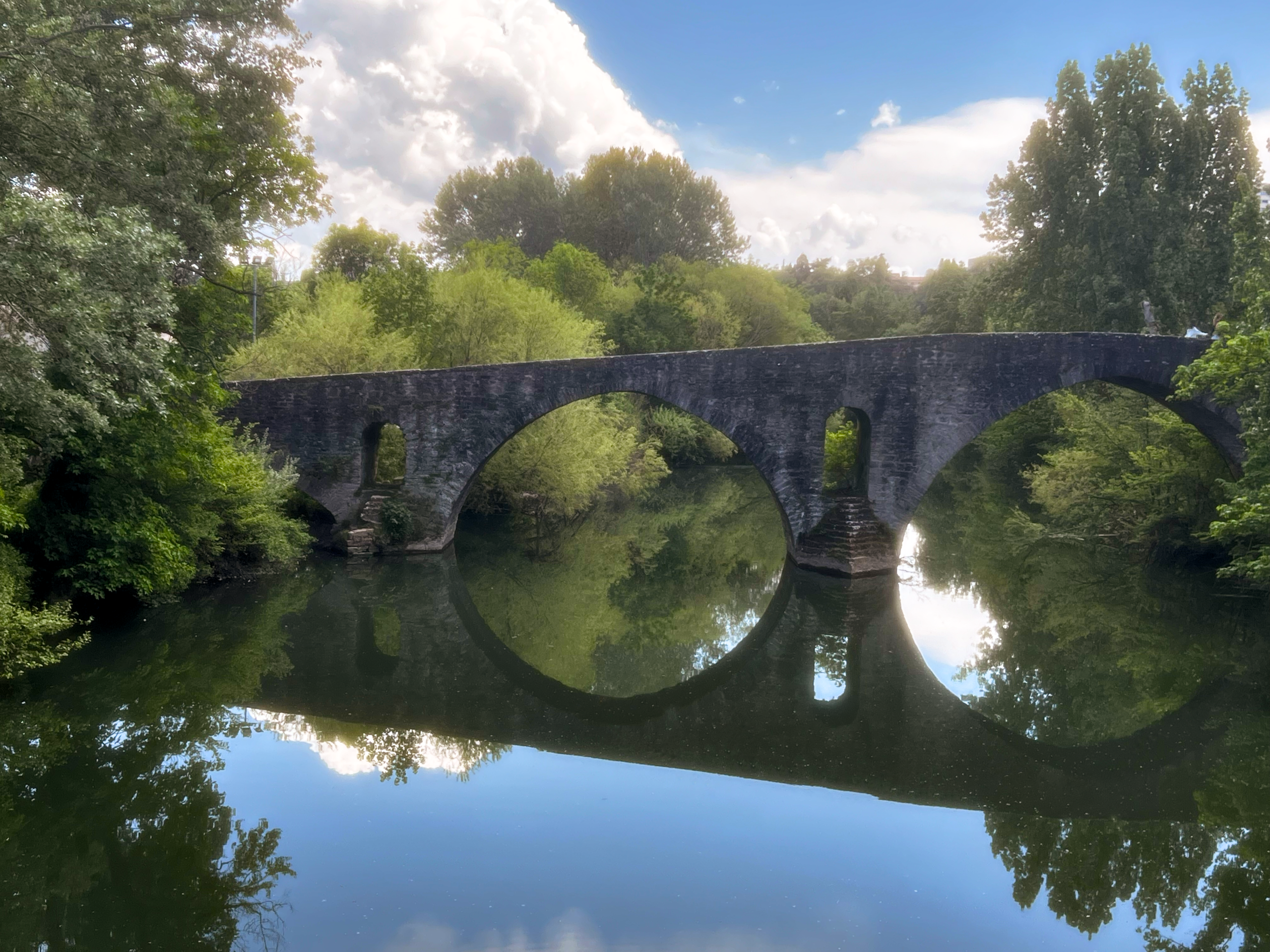
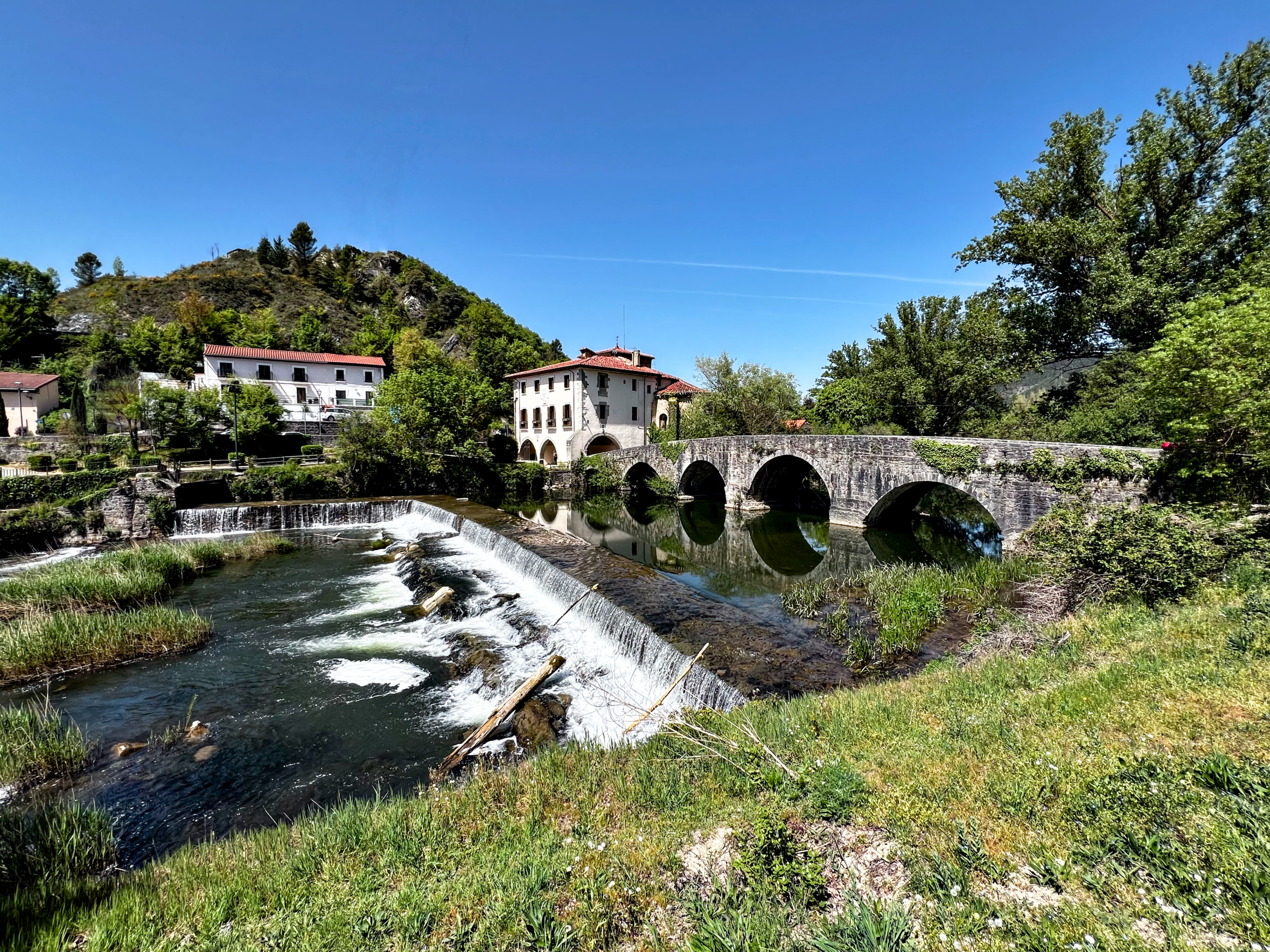
Puente la Reina means the Queen’s Bridge. The Romanesque bridge over the River Arga dates to the 11th century and gave pilgrims a reliable crossing on their route west. Its stone arches have become one of the defining images of the Camino de Santiago.
It looks less constructed than grown from the riverbanks.
Sage and I crossed it together.
After the wind on Alto del Perdón and the loose-rock punishment on the other side, stepping onto that bridge felt like more than completing another stage. Pilgrims had approached this place by separate roads for centuries. From here, the journey continued as one Camino toward Estella, Logroño, Burgos, León, and eventually Santiago de Compostela.
For once, our sore feet felt connected to something larger than themselves.
Day 9, in the bank.
Over forgiveness.
Down the brutal back.
Across the Queen’s Bridge.
Onto the road we would all share.
Things to Do in Puente la Reina After Walking

Puente la Reina deserves more than an exhausted march to your bed. Fortunately, its compact historic center makes it possible to explore without launching a second expedition.
The official Puente la Reina-Gares visitor route follows the Camino through Calle Crucifijo and Calle Mayor toward the Romanesque bridge.
Cross the Romanesque Bridge Again
You will cross the bridge as part of the Camino, but return later without your backpack if your legs permit it. From the riverbank, you can better appreciate the arches and the way the bridge connects the medieval town with the trail continuing west.
Walk Calle Mayor Slowly
Calle Mayor forms the historic spine of Puente la Reina. It is not merely a route between landmarks. The street itself tells the story of a town developed around the movement of pilgrims.
Visit the Church of the Crucifix
The Church of the Crucifix stands near the eastern Camino entrance. Its unusual Y-shaped crucifix is the feature most visitors remember. Opening hours can vary around services and seasons, so check locally rather than trusting an old timetable.
Step Inside the Church of Santiago
The Church of Santiago el Mayor sits along Calle Mayor and contains surviving Romanesque elements despite later reconstruction. It is an easy cultural stop while crossing the old center.
Sit Beside the River Arga
Not every Camino town needs to become a sightseeing competition. Find a place near the river, remove your shoes if socially appropriate, and let the day stop moving.
Sometimes that is the attraction your body actually requested.
Where to Stay in Puente la Reina

Puente la Reina has municipal and private albergues, pensions, guesthouses, and small hotels. Choose according to what your body needs—not according to what sounds most authentically pilgrim on social media.
| Accommodation type | Best for | What to check |
| Pilgrim albergue | Budget travelers and a communal Camino evening | Opening dates, credential rules, reservations, curfew, kitchen, and laundry |
| Private albergue | More booking certainty or smaller dorm rooms | Linens, lockers, bed layout, breakfast, and cancellation policy |
| Pension or guesthouse | Couples and light sleepers | Private bathroom, stairs, check-in time, and route location |
| Small hotel | Rest, privacy, or injury recovery | Elevator, air conditioning, breakfast time, and luggage delivery |
Private rooms can disappear quickly in busy spring and autumn periods, particularly for couples. Book ahead if privacy, an elevator, or a specific bed arrangement is important.
Where We Stayed in Puente la Reina
We stayed at Albergue de Peregrinos Santiago Apóstol in Puente la Reina. By the time we arrived, Sage and I were exhausted. A hot shower, freshly washed laundry, and the chance to stop moving felt almost luxurious after the climb and rocky descent from Alto del Perdón.
Later, we shared a pilgrim meal with other people walking the Camino Francés. We ate with Wil—short for Wilma—and her husband. These communal dinners became one of my favorite parts of the Camino. You might begin the evening as strangers from different corners of the world, but exhaustion, food, and a shared trail have a way of quickly dissolving those barriers.
We also slept remarkably well that night, which was exactly what our bodies needed.
Sage’s leg was bothering her, so we needed to reduce the weight she would carry the following day. The hospitalero arranged luggage transfer for my backpack. That allowed me to carry Sage’s pack while mine traveled ahead to our next destination. It was a practical adjustment rather than part of our original plan, but the Camino continually reminded us that adapting is not the same as giving up.
Food, Water, and Camino Services
Puente la Reina is a practical overnight stop with restaurants, cafés, food shops, pharmacies, and pilgrim accommodation. Hours change by weekday and season, so handle essential errands before becoming emotionally attached to a post-walk chair.
Before leaving Zariquiegui:
- Carry enough water to reach Uterga without relying on a summit vendor.
- Pack a snack for the climb and descent.
- Check wind, heat, and rain forecasts.
- Confirm your accommodation’s check-in policy.
After reaching Puente la Reina:
- Buy supplies for the next stage before shops close.
- Inspect your feet before a small problem becomes tomorrow’s entire personality.
- Refill water and check the next day’s weather.
- Confirm luggage collection if you are using a transfer service.
What to Expect From Zariquiegui to Puente la Reina
This is a short stage by Camino standards, but it should not be mistaken for an effortless one.
Expect an exposed climb immediately after leaving Zariquiegui. Alto del Perdón can be windy even when conditions below feel mild. The summit offers one of the best-known views and monuments on the Camino Francés, but the loose-rock descent toward Uterga requires more concentration than the ascent.
After Uterga, the walking becomes easier. The route passes through Muruzábal and Obanos before entering Puente la Reina. Food and water may be available in the villages, but seasonal hours mean you should still leave with the essentials.
This split works especially well if:
- You are following a slower Camino itinerary.
- You recently needed a rest day in Pamplona.
- Descents are harder on your knees than climbs.
- You want unhurried time at Alto del Perdón.
- You prefer a flexible 14–18 km rhythm over guidebook stages.
The traditional Pamplona-to-Puente la Reina stage is approximately 24 kilometers and works for many pilgrims. It simply was not the right shape for our Camino.
Plan Your Camino de Santiago
Continue preparing for your pilgrimage with these Camino guides:
- Camino de Santiago: The Complete Guide to Walking the Way
- Camino Francés: Route, Stages, and Planning Guide
- What to Pack for the Camino de Santiago
- How to Train for the Camino de Santiago
- Camino Albergues: What First-Time Pilgrims Should Expect
- Choosing the Best Camino de Santiago Route
Why Splitting the Pamplona Stage Worked for Us
Guidebooks make stages look official.
Pamplona to Puente la Reina.
Roncesvalles to Zubiri.
Puente la Reina to Estella.
Clean lines. Tidy distances. A schedule that appears to have arrived on stone tablets carried by Saint James himself.
It did not.
Stages are planning conventions. They are useful, but they do not know your age, injuries, sleep quality, walking pace, or how your knees feel after several days under a backpack.
Sage and I built our Camino around shorter distances because we wanted enough margin to experience the journey. Stopping in Zariquiegui let us face Alto del Perdón with fresher legs. It also prevented the descent from becoming the final exhausting obstacle in a 24-kilometer day.
Splitting the stage did not remove the difficulty.
It gave us room to meet it.
That distinction became more important with every kilometer toward Santiago.
Puente la Reina Camino de Santiago FAQs

What Day 9 Taught Me
There is more than one honest way to reach the same place.
Our route from Zariquiegui to Puente la Reina was much shorter than the traditional stage from Pamplona. Yet the wind, climb, and descent demanded our full attention.
Shorter did not mean effortless.
It meant we had enough margin to experience what the trail was asking from us.
At Alto del Perdón, metal pilgrims from different centuries lean into the same wind. Near Puente la Reina, pilgrims arriving by different routes join the same westward road.
The Camino kept repeating the lesson in geography.
Different beginnings do not make one journey more legitimate than another. Different distances do not make one pilgrim more authentic. We arrive with separate histories, cross the same bridge, and continue together.
Atypical Last Thoughts

Day 9 gave me everything people photograph about this part of the Camino Francés: the wind turbines, the iron pilgrims, the enormous views, and Puente la Reina’s medieval bridge.
It also gave me the part photographs rarely explain.
The stones move.
The descent hurts.
Your knees do not care how meaningful the summit inscription was.
Splitting the traditional Pamplona stage in Zariquiegui gave Sage and me the space to experience Alto del Perdón instead of racing over it. By the time we crossed the Queen’s Bridge, the day felt complete—not because we had walked the maximum possible distance, but because we had walked the distance that made sense for us.
Walk your own stage.
Respect the descent.
Meet the others at the bridge.
Buen Camino.
What’s Next on the Camino?
The Queen’s Bridge is not the finish line. On the western bank, the yellow arrows continue toward Mañeru, Cirauqui, and Estella-Lizarra.
Continue the journey:
← Day 8: Pamplona to Zariquiegui
Day 10: Puente la Reina toward Estella-Lizarra →
Meet Carter

I’m Carter, an American traveler living in Portugal and the creator of Atypical Vagabond. After selling my technology business, I traded the conventional path for slow travel, life abroad, and a slightly unreasonable number of long walks across Europe. I share honest Portugal guides, Camino stories, digital nomad advice, and practical lessons to help you explore the world with greater confidence and purpose.
Subscribe
Looking for honest travel inspiration without the polished influencer nonsense?
Join the Atypical Vagabond newsletter for offbeat destination guides, Portugal travel tips, digital nomad lessons, slow travel stories, and the occasional reminder that the ordinary path is wildly overrated.
I share the victories, wrong turns, hidden gems, and real-life chaos that come with building a life around travel. No corporate fluff. No recycled bucket lists. Just useful advice, personal stories, and unconventional adventures designed to help you travel deeper, stay curious, and create your own damn route.
Subscribe and let’s reject the ordinary together.
Donations
Enjoying the stories, guides, videos, and occasional travel disaster here at Atypical Vagabond?
A small donation helps cover the real costs behind the adventures—from transportation and website hosting to camera gear, research, and enough coffee to keep the next guide moving.
There are no giant sponsors pulling the strings and no polished corporate travel machine hiding backstage. Your support helps me continue creating honest travel stories, practical Portugal guides, digital nomad advice, and unconventional adventures for travelers who prefer the road less rehearsed.
Every contribution helps keep Atypical Vagabond independent.
Fuel the next adventure through PayPal—and help me keep rejecting the ordinary.
One response to “Puente la Reina Camino de Santiago: A Practical Stage Guide from Zariquiegui”
-
[…] The following morning, we climbed Alto del Perdón, stood beside the iron pilgrims, passed the fountain connected to one of the Camino’s enduring legends, and began the difficult descent toward my Puente la Reina Camino de Santiago stage. […]

Leave a Reply